
What Does B1 Mean On A Honda Accord? (Protect Your Accord)
If you own a Honda Accord and suddenly see B1 pop up on the dashboard, do not panic, but do not ignore it either. This code is not random, and it is not Honda trying to scare you into spending money. In routine Honda service work, B1 is one of the most common reminders I see drivers misunderstand.
This article breaks down what B1 actually means, what service Honda expects, and how urgent it really is, so you can make the right decision without guessing.
What Is Honda’s Maintenance Minder System?
Honda uses a system called Maintenance Minder to decide when your car actually needs service. It does not follow a fixed mileage schedule.
Instead, it looks at:
- engine temperature
- mileage
- How you drive
Here is a real example I see often: a friend who drives a 2020 Accord mostly in city traffic sees B1 around 7,500 miles. Another relative who drives mostly highways usually reaches 10,000 miles before the same code appears.
In real-world service bays, city-driven Accords almost always trigger B1 earlier than highway-driven ones.
Honda adjusts maintenance timing based on real usage, not guesses.
Why it matters:
- Helps prevent engine wear
- Avoids unnecessary early services
- Saves money over the life of the car
How it works:
Sensors monitor oil life, engine temperature, and driving patterns.
When service is due, a code appears on the dashboard.
Short city trips, stop-and-go traffic, and frequent hard acceleration all make the B1 code appear sooner. That is normal. It is a personalized reminder, not a scare tactic.
Why Does Honda Use Maintenance Codes?
Honda uses maintenance codes to make car care simpler and more accurate. Instead of guessing when to service your car, the system tells you exactly what it needs.
From real shop experience, drivers who ignore these reminders often end up with:
- engine sludge
- uneven tire wear
- premature brake repairs
Catching B1 early usually saves hundreds of dollars later.
When these reminders are ignored, we usually see problems that could have been avoided with a simple B1 service.
How Does Honda Calculate Service Needs?
Honda calculates service timing using several real-world factors:
- mileage
- engine load
- operating temperature
- driving habits such as short trips or aggressive driving
This is why two Accords with the same mileage can show B1 at different times. The system reflects actual wear, not just miles.
Honda’s maintenance logic also depends on engine design, including whether it uses a timing chain or belt.
Also Read: Do Honda Accords Have Timing Belts Or Chains?
What Does the B1 Code Mean on a Honda Accord?
B1 is Honda’s way of saying your car needs basic maintenance plus tire rotation.
- B Service: oil change, filter replacement, brake inspection, steering and suspension checks, fluid checks, and tire condition inspection
- 1 Sub-Code: tire rotation and alignment check if wear looks uneven
I have personally seen drivers ignore B1 for thousands of miles. When they finally come in, the tires are worn unevenly, and the brake pads are halfway gone. That is an expensive lesson.
By the time a driver comes in after skipping B1 for months, tire wear is already uneven, and brake life is halfway gone.
Tire rotation only works if your tire pressure is correct. Many drivers miss this part completely.
Also Read: What PSI Should Honda Accord Tires Be?
What Is Included in Honda B1 Service?
During a standard B1 service, a Honda technician usually performs:
- Engine & Oil: replace oil and filter to prevent sludge buildup
- Tires: rotate front and rear tires for even wear
- Brakes: inspect pads, rotors, and brake fluid
- Suspension & Steering: check joints, bushings, and linkages
- Fluids: inspect transmission, coolant, brake, and washer fluids
- Exhaust & Fuel Lines: visual check for leaks or damage
This inspection protects both your engine and your tires, which are two of the most expensive parts to neglect.
What Happens If You Ignore the B1 Code?

Ignoring the B1 code on your Honda Accord may seem harmless, but in real-world experience, it quickly leads to preventable damage. B1 is not just an oil reminder; it signals routine maintenance plus tire rotation. Skipping it for months can cause:
- Engine wear and sludge buildup: Oil breaks down over time. Without replacement, contaminants accumulate, reducing lubrication and increasing friction. In my service experience, city-driven Accords that ignored B1 often develop sludge pockets around valve trains within 8,000 to 10,000 miles.
- Uneven tire wear: The 1 in B1 indicates tire rotation. Skipping a rotation causes uneven tread wear, reduces grip, and requires premature tire replacement. I have seen cars lose 30 to 40% of tire life just from neglecting this step.
Brake and suspension stress: Tires and brakes work together. When tires wear unevenly, brake pads wear faster, and suspension components face extra strain. In practice, even a 5,000-mile delay in a B1 can lead to uneven pad wear and noisy suspension joints. - Higher repair costs: Minor delays turn into major expenses. Replacing sludge-affected engine parts or tires can cost hundreds to over a thousand dollars, all of which can be avoided with timely B1 service.
Key takeaway:
The B1 code is a personalized, adaptive reminder, based on driving style, engine load, and mileage. Treat it like a preventive checkup for your car’s health. Short trips are usually fine, but ignoring B1 consistently leads to avoidable wear and expensive repairs. Following the B1 schedule ensures your Accord remains reliable, efficient, and safe.
How Much Does Honda B1 Service Cost?
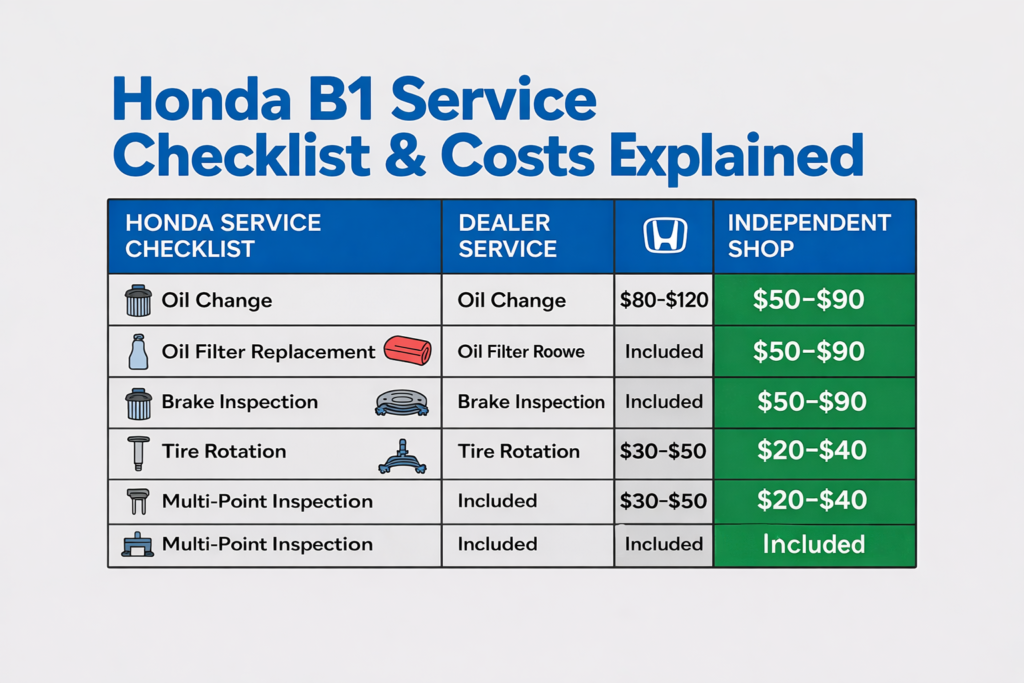
Costs depend on where you go:
- Dealer: $180 to $300 (OEM parts, official service record)
- Independent mechanic: $120 to $200 (quality depends on the shop)
- DIY: oil and filter $40 to $70, tire rotation $10 to $20
Pro tip: Combining B1 service with other minor work at an independent shop can easily save $50 to $150 per visit.
Prices vary widely because labor rates and oil quality differ more than most drivers realize.
Does B1 Service Affect Warranty or Resale Value?
Yes. Skipping required maintenance can affect warranty claims and resale value.
Buyers trust service records. A well-documented Accord with timely B1 services is easier to sell and holds more value than one with gaps in its maintenance history.
From resale inspections I have seen, missing routine services like B1 almost always raise red flags for buyers.
Maintenance history affects resale differently depending on trim level and buyer expectations.
Also Read: What Are The Honda Accord Trim Levels?
Can You Drive With the B1 Service Due?
Short trips are usually fine. Driving for months without service is not.
Long-term neglect can lead to:
- engine sludge
- uneven tire wear
- worn brakes
- higher repair costs
Even a few thousand miles of delay can turn a simple service into a costly repair.
How Often Does the Honda B1 Code Appear?
Most Honda Accords show B1 around 7,500 to 10,000 miles.
City drivers usually see it sooner due to stop-and-go traffic and short trips. Highway drivers often reach the higher end of that range.
If you are wondering how long a Honda Accord can realistically last, routine services like B1 are more important than most drivers realize.
Also Read: How Many Miles Can A Honda Accord Get?
What is the Difference Between Honda A and B Service?
| Service | What is Included | Typical Interval |
| A | Oil + basic inspection | Every 7,500 to 10,000 miles |
| B | Oil, filter, inspection, tire rotation | Every 15,000 to 20,000 miles |
Quick summary:
- A Service: basic maintenance
- B Service: more detailed, preventive service
How Do You Reset the Honda B1 Service Light?
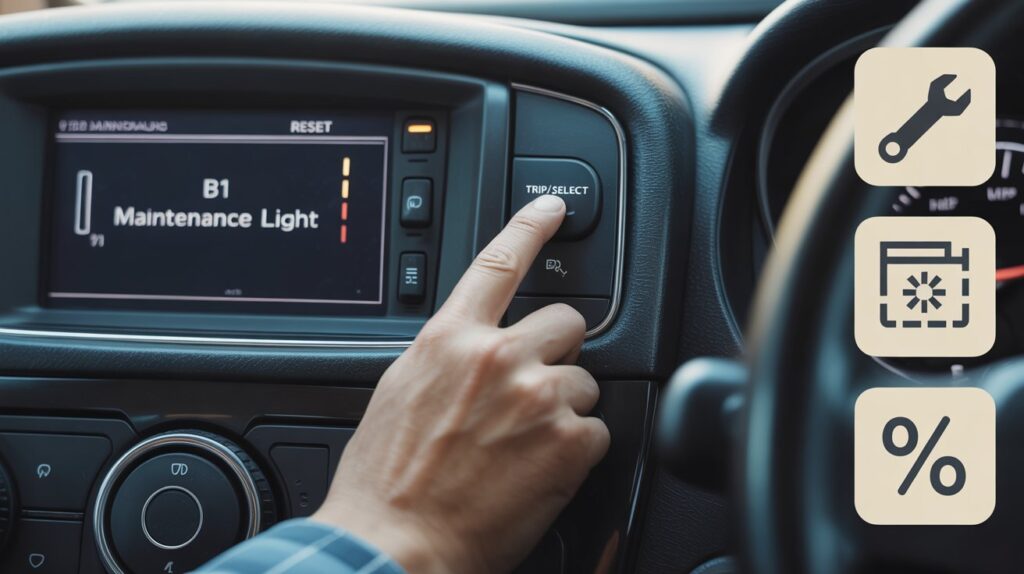
Only reset the light after service.
Steps:
- Turn ignition ON (engine off)
- Press Trip/Select until oil life appears
- Hold the button for 10 seconds until it blinks
- Release, then hold again for 5 seconds
Resetting without service defeats the purpose of the reminder.
How Can You Save Money on Honda Accord B1 Service?
- Use a trusted independent mechanic
- Do oil and filter replacement yourself if experienced
- Combine tire rotation with other services
- Look for dealer or local shop coupons
Small choices can save $50 to $150 every visit.
What are the common myths about the Honda B1 Code?
- Myth 1: B1 is just an oil change
Truth: It includes inspections and tire rotation - Myth 2: I can ignore it safely
Truth: Delaying often leads to expensive repairs - Myth 3: Dealers made it up to make money
Truth: It is a real preventive system designed by Honda engineers
FAQs:
Does B1 mean my Honda Accord has a serious problem?
No. It is a maintenance reminder, not a fault.
Do I need to change the oil when B1 appears?
Yes. It signals oil and filter replacement plus inspections.
Can I drive my Honda a short distance with B1 on?
Yes, short trips are fine, but do not ignore them in the long term.
Is tire rotation included in B1 service?
Yes, the 1 specifically indicates tire rotation.
Will ignoring B1 affect my car’s warranty?
Yes. Skipping service can void warranty claims and reduce resale value.
Conclusion:
The B1 code is a routine maintenance reminder, not a warning. Addressing it on time helps prevent avoidable engine wear, uneven tire damage, and unnecessary repair costs. Consistent B1 service keeps your Honda Accord reliable, efficient, and easier to maintain over the long term.