
Is the Honda Accord Hybrid Worth Buying? (Final Verdict)
The Honda Accord Hybrid is worth buying for most commuters who want excellent fuel economy, a comfortable cabin, and strong long-term reliability. It performs especially well in city driving, where its hybrid system can reduce fuel consumption significantly compared with a traditional petrol sedan. However, whether it is worth buying depends on your driving habits, ownership goals, and budget.
In this guide, we will look at real-world fuel economy, reliability, ownership costs, common drawbacks, and how the Accord Hybrid compares with rivals like the Toyota Camry Hybrid.
What Makes the Honda Accord Hybrid Different?
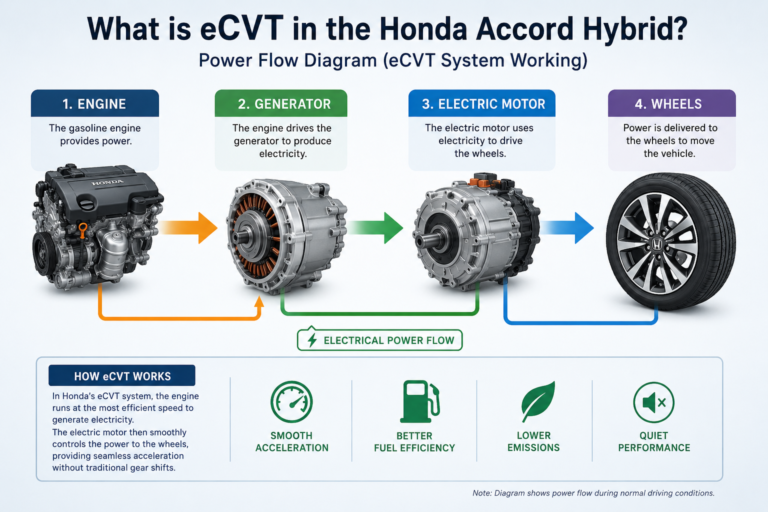
How the Hybrid System Actually Works
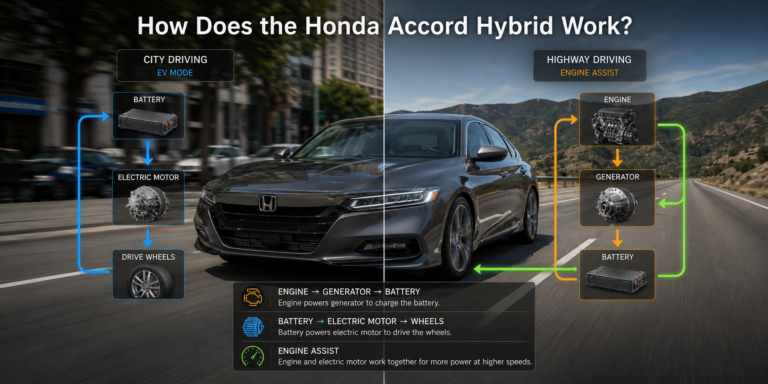
The Honda Accord Hybrid uses a two-motor system where the electric motor handles most city driving while the petrol engine mainly generates electricity. At higher speeds, the engine can directly assist. This setup improves hybrid system design and reduces fuel waste in stop-and-go traffic without needing plug-in charging.
Also Read: How Does The Honda Accord Hybrid Work?
Difference Between the Hybrid and Regular Accord
| Feature | Accord Hybrid (2023 to 2026 style) | Regular Accord (Gas) |
| Engine Feel | Electric-first drive response | Traditional engine power |
| Fuel Economy | Much higher MPG | Lower MPG |
| City Driving | More EV assist behavior | Less efficient |
| Maintenance | Slightly complex system | Simpler mechanics |
The hybrid performs better in stop-and-go traffic, while the regular version is simpler and cheaper upfront.
How Much More Does the Accord Hybrid Cost?
The Accord Hybrid typically costs more than an equivalent petrol Accord when new. However, the additional cost can often be offset through fuel savings over several years of ownership.
Drivers who cover high annual mileage usually recover the price difference faster than drivers who only travel short distances occasionally.
Buyers planning to keep the vehicle for many years generally benefit most from the hybrid model.
Is the Honda Accord Hybrid Worth It for Daily Driving?
Real-World Fuel Economy in City Driving
In traffic-heavy conditions, the Accord Hybrid performs best. It often runs on EV mode operation at low speeds, which reduces fuel burn significantly compared to gas-only sedans. MPG variation depends heavily on traffic conditions and driving style.
This is where economy gains are most visible compared to traditional petrol engines, especially during frequent braking and acceleration cycles. Cold weather can also reduce short-distance hybrid efficiency because the petrol engine runs longer during startup, and battery temperatures remain lower during initial driving cycles.
Highway Performance and Comfort
On highways, the hybrid stays stable and confident. The engine remains quiet at cruising speeds, and cabin noise stays controlled. It is not tuned for sporty driving but focuses on steady drivetrain response and long-distance usability.
Traffic Driving Experience and Smoothness
In slow-moving traffic, the system constantly switches between electric and engine support. The regenerative braking system recovers energy during deceleration and stores it in the battery. This recovered energy helps support electric driving and improves fuel efficiency in city traffic.
Also Read: How Regenerative Braking Works In The Accord Hybrid
Honda Accord Hybrid Pros and Cons
Pros
- Excellent fuel economy in city driving
- Smooth and quiet driving experience
- Spacious rear seat and comfortable cabin
- Strong safety ratings
- Good resale value
- Proven hybrid technology
Cons
- Fuel economy advantage decreases during sustained highway driving
- Higher purchase price than the petrol model
- Less engaging to drive than performance-oriented sedans
- Slightly reduced cargo space due to battery packaging
- Hybrid component repairs can be expensive outside warranty
Fuel Economy and Real Savings Explained:
Real MPG vs Official EPA Ratings
Official ratings are often slightly higher than actual use, but the Accord Hybrid still performs close to expectations. Driving style and traffic conditions play a big role in final mileage results, especially due to regenerative braking efficiency.
How Much Money You Actually Save on Fuel
| Driving Type | Gas Accord | Accord Hybrid | Monthly Fuel Savings |
| City Driving | Higher fuel use | Low fuel use | High savings |
| Highway | Moderate use | Lower fuel use | Medium savings |
| Mixed Use | Average | Better average | Noticeable savings |
In typical daily commuting, especially on congested routes, the hybrid system reduces fuel consumption mainly during low-speed electric operation phases. Savings are more noticeable in city use than in highway driving.
Estimated Five-Year Ownership Costs
| Expense | Accord Hybrid |
|---|---|
| Fuel | Lower |
| Routine Maintenance | Similar |
| Insurance | Slightly Higher |
| Repairs | Slightly Higher |
| Resale Value | Strong |
While exact ownership costs vary by location and driving habits, the Accord Hybrid generally offsets part of its higher purchase price through reduced fuel expenses and strong resale value.
Does Driving Style Affect Efficiency?
Yes, aggressive acceleration reduces efficiency. Calm driving improves EV mode operation and allows the hybrid drivetrain system to recover more energy effectively.
Performance and Driving Feel:
Acceleration and Instant Torque
The electric motor gives instant torque, making city acceleration responsive. It may not feel sporty, but drivetrain response remains predictable during daily driving.
Is the Accord Hybrid Fun To Drive?
Most drivers buy the Accord Hybrid for quieter commuting and lower running costs rather than sporty performance. It feels more relaxed than aggressive behind the wheel.
Handling Compared to Other Hybrid Sedans
The Accord Hybrid handles well for its class. It feels stable in corners while maintaining suspension tuning focused on daily road comfort.
Reliability and Long-Term Ownership:
Hybrid Battery Lifespan and Concerns
Modern Honda hybrid batteries are designed for long-term use and are covered by extensive warranty protection in many markets. Many owners report well over 100,000 miles of battery life without major issues, although replacement costs can be significant if a battery eventually fails outside warranty coverage.
Modern Honda hybrid systems use improved thermal control and energy management logic to stabilize battery performance during repeated charge-discharge cycles, especially in hot climates and frequent stop-and-go driving.
Maintenance Costs vs Gas Models
Maintenance is slightly different but not expensive overall. Regenerative braking reduces brake wear, though hybrid components may cost more if repairs are needed. Many owners also report fewer brake replacement intervals compared to traditional petrol sedans because regenerative braking handles part of the deceleration workload.
Common Problems Reported by Owners
- Occasional software updates required
- Minor sensor or electronic alerts
- Rare hybrid system warning issues
Most issues are not serious and remain uncommon in 2020 to 2026 models.
What Owners Like Most About the Accord Hybrid
Owners frequently praise the Accord Hybrid for:
- Quiet cabin
- Smooth low-speed driving
- Excellent fuel economy
- Comfortable ride quality
- Spacious rear seating
- Low day-to-day operating costs
These strengths appear consistently across owner reviews and long-term ownership reports.
Interior Comfort and Technology:
Passenger Space and Cabin Comfort
The Accord Hybrid offers a roomy cabin suitable for families and long-distance travel. Rear legroom remains one of the strongest in its class.
Infotainment and Driver Assistance Features
It includes touchscreen controls, smartphone integration, and Honda Sensing safety features like adaptive cruise control and lane assist.
Cargo Space and Practical Use
Boot space is slightly reduced due to battery placement, but still practical for daily luggage and family use.
Is the Honda Accord Hybrid Good for Long Trips?
Highway Fuel Economy
Highway mileage remains strong but less dramatic than city performance. At steady highway speeds around 70 to 75 mph, the petrol engine stays active more consistently, so fuel economy gains become smaller compared to slow urban traffic conditions. It still outperforms most non-hybrid sedans.
Ride Comfort on Long Drives
Suspension tuning absorbs road bumps well, making long trips stable and less tiring for passengers.
Driver Fatigue and Ease of Use
Quiet cabin, balanced power delivery, and adaptive cruise control reduce fatigue on long journeys.
Honda Accord Hybrid vs Competitors
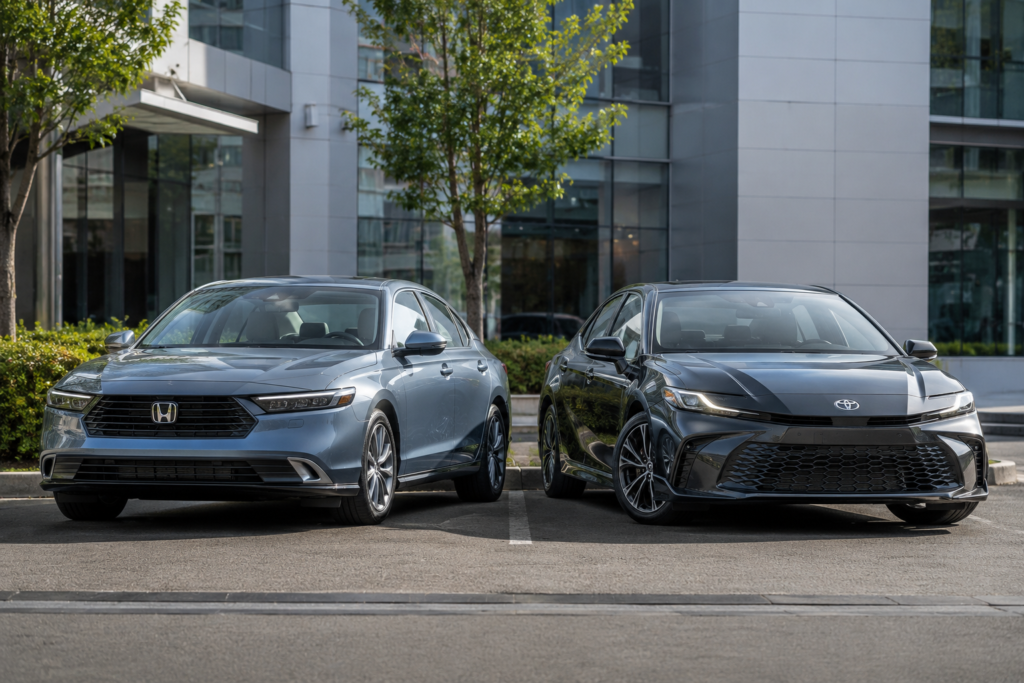
Honda Accord Hybrid vs Toyota Camry Hybrid
| Factor | Accord Hybrid | Camry Hybrid |
| Driving Feel | More refined | Slightly sportier |
| Fuel Economy | Very strong | Very strong |
| Interior Space | Larger cabin | Slightly smaller |
| Ride Quality | Softer tuning | Balanced ride |
Fuel Economy and Performance Comparison
Both models deliver strong mileage, but the Accord Hybrid feels more relaxed while the Camry Hybrid has slightly sharper driving dynamics. The difference becomes more noticeable in dense traffic, where the Accord Hybrid prioritizes quieter low-speed operation over sharper throttle response.
Reliability and Ownership Costs
The Camry Hybrid is often preferred for its long-term durability reputation, while the Accord Hybrid leans toward interior space and smoother low-speed driving behavior in urban environments.
Who Should Buy the Honda Accord Hybrid?
Best for City Commuters
Ideal for heavy traffic users where EV assist behavior reduces fuel consumption.
Best for High-Mileage Drivers
Best for long-distance drivers looking to reduce fuel costs significantly.
Who Should Avoid It
Not ideal for buyers who want sporty performance or the lowest upfront cost.
Used Honda Accord Hybrid: Is It Worth It?
What to Check Before Buying Used
Check battery health, service history, and software updates before purchase.
Best Model Years to Consider
2021 to 2026 models are more dependable due to improved hybrid power delivery and software upgrades.
Cost of Ownership Breakdown
Insurance Costs
Slightly higher than gas models due to hybrid components, but still reasonable.
Maintenance and Repair Expenses
Routine maintenance is affordable, but hybrid repairs can be costly in rare cases.
Resale Value and Depreciation
Strong resale value due to demand for fuel-conscious hybrid sedans.
Safety Ratings and Driver Confidence
Crash Test Ratings
Consistently high safety scores make it a strong family sedan.
Honda Sensing Safety Features
Includes lane assist, adaptive cruise control, and collision mitigation systems.
Common Myths About the Honda Accord Hybrid
Hybrid Batteries Fail Early
Modern batteries are designed for long life and rarely fail under normal use.
Hybrids Are Slow
Electric assist improves low-speed response and makes city driving feel responsive.
Maintenance Costs Are Too High
Routine maintenance is similar to that of regular cars; only major repairs are expensive.
Final Verdict: Is It Worth Buying in 2026?
Best Reasons to Buy
Lower fuel consumption, refined driving behavior, and a hybrid-assisted power delivery make it a strong daily commuter sedan.
When It is Not Worth It
If you want sporty driving or the lowest upfront cost, a petrol sedan may be better.
Final Recommendation by Buyer Type
For commuters and high-mileage drivers, it is a strong choice. For performance-focused users, it may feel too calm and practical.
FAQs:
Is the Honda Accord Hybrid good for daily city driving?
It performs very well in city traffic due to EV mode operation and lower fuel consumption in stop-and-go conditions.
Does the Honda Accord Hybrid really save money on fuel?
Yes, it reduces fuel consumption significantly over time, especially for daily commuters in urban driving.
Is the Honda Accord Hybrid reliable for long-term ownership?
Modern models have strong durability and an improved battery management system control.
Does the Honda Accord Hybrid feel slow compared to gas cars?
Electric torque gives a quick, low-speed response, making it feel responsive in daily traffic.
Is the Honda Accord Hybrid expensive to maintain?
No, routine maintenance is similar to that of regular cars, with only rare hybrid repairs costing more.
Is the Honda Accord Hybrid Battery Covered Under Warranty?
Yes. Most Honda Accord Hybrid models include hybrid battery warranty coverage, though the exact duration varies by model year and market.
How Many Miles Can a Honda Accord Hybrid Battery Last?
Many Accord Hybrid batteries last 150,000 to 200,000+ miles with normal use, and battery failures are relatively uncommon.
Is the Accord Hybrid Better Than the Regular Accord?
For most commuters, yes. The Hybrid offers better fuel economy and lower fuel costs, while the regular Accord is cheaper to buy initially and mechanically simpler.
Conclusion:
The Honda Accord Hybrid is one of the best midsize hybrid sedans available for buyers who prioritize fuel economy, comfort, and long-term reliability. Its biggest strengths appear in city driving, where the hybrid system can significantly reduce fuel consumption without requiring plug-in charging.
It is not the cheapest sedan to buy initially, and drivers looking for sporty performance may prefer other options. However, for commuters, families, and high-mileage drivers, the Accord Hybrid offers an excellent balance of efficiency, practicality, technology, and ownership value.
If your goal is to reduce fuel costs while maintaining the comfort and reliability that the Accord is known for, the Accord Hybrid is absolutely worth considering in 2026.
Sources
- Honda Accord Hybrid Owner’s Manual
- Honda Newsroom Technical Information
- U.S. EPA Fuel Economy Database
- NHTSA Vehicle Safety Information
- Consumer Reports Reliability Data
- RepairPal Ownership Cost Data