
How Often Does a Honda Accord Need an Oil Change? (Complete Guide by Model Year)
Most Honda Accords need an oil change every 7,500 to 10,000 miles when using full synthetic oil, but the exact interval depends on the model year, engine type, driving conditions, and the Honda Maintenance Minder system. Following the correct schedule can help prevent premature engine wear, oil dilution problems, and expensive timing chain repairs.
In this guide, we break down exact intervals by model year, explain how the Honda Maintenance Minder works, and help you avoid the most common (and costly) oil change mistakes Accord owners make.
Why Oil Changes Matter More Than You Think
Engine oil is not just a lubricant. It does four critical jobs inside your Honda Accord’s engine:
- Reduces friction between metal parts moving at high speed
- Carries away heat from the combustion chamber
- Suspends dirt and metal particles so they do not scratch engine surfaces
- Protects seals and gaskets from drying out and cracking
When oil gets old, it breaks down. It turns dark, becomes thick, and loses its ability to flow through tight engine passages. The result is not just reduced performance; it can mean sludge buildup, bearing damage, and, in serious cases, complete engine failure.
The 1.5T Accord engine benefits from regular oil changes because fresh oil helps minimize the effects of fuel dilution and protects timing-chain components over the long term.
Skipping oil changes accelerates engine wear and can contribute to timing chain, turbocharger, and internal engine problems over time.
Honda Accord Oil Change Intervals by Year
Here is a breakdown of recommended oil change intervals based on the actual Honda guidelines for each generation:
| Model Year | Engine | Recommended Interval | Oil Type |
| 1998 to 2002 | 2.3L 4-cyl / 3.0L V6 | Every 3,000 to 5,000 miles | Conventional |
| 2003 to 2007 | 2.4L 4-cyl / 3.0L V6 | Every 5,000 miles | Conventional or Synthetic |
| 2008 to 2012 | 2.4L 4-cyl / 3.5L V6 | Every 5,000 to 7,500 miles | Full Synthetic Recommended |
| 2013 to 2017 | 2.4L 4-cyl / 3.5L V6 | Follow Maintenance Minder | 0W-20 Full Synthetic |
| 2018 to 2022 | 1.5T / 2.0T | Follow Maintenance Minder | 0W-20 Full Synthetic |
| 2023 to Present | 1.5T / 2.0T / Hybrid | Follow Maintenance Minder | 0W-20 Full Synthetic |
Quick Recommendation
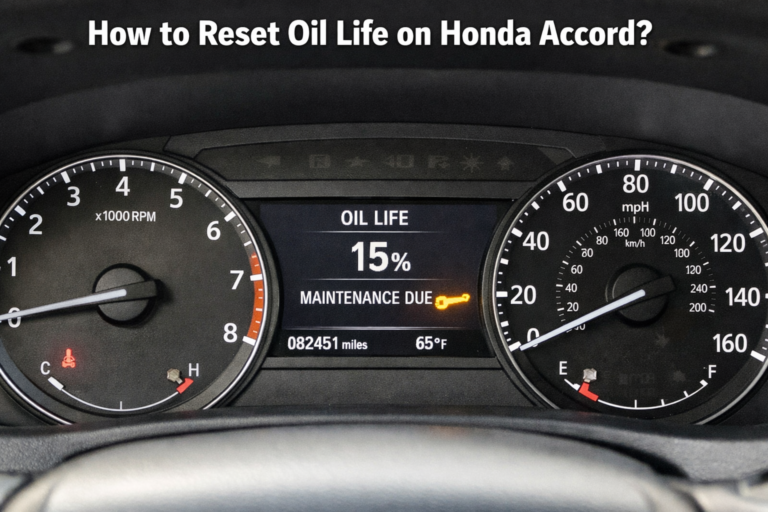
For most Honda Accord owners, changing full synthetic oil when the Maintenance Minder reaches 15% oil life provides the best balance between engine protection and maintenance cost.
Important: For 2013 and newer Accords, Honda officially recommends following the Maintenance Minder system, not a fixed mileage schedule.
How the Honda Maintenance Minder Actually Works
Many drivers assume the Maintenance Minder is just a mileage countdown timer. It is not.
The system uses real-time data from your engine to calculate oil life:
- Engine RPM and load
- Engine temperature and coolant temperature
- Number of cold starts
- Trip length (short trips are harder on oil than highway driving)
- Outside temperature
Based on all these factors, it calculates how much useful life is left in your oil and displays it as a percentage on your dashboard.
What the Oil Life Percentage Means:
| Oil Life % | What It Means | What You Should Do |
| 100% | Fresh oil, just changed | Nothing |
| 50% | Oil is working, halfway through its life | Monitor normally |
| 15% | Oil life is getting low | Schedule your oil change soon |
| 5% or below | Change oil now | Do not delay; book immediately |
| 0% | Oil is past due | Change oil immediately |
The Maintenance Minder is accurate because it accounts for how you actually drive, not just how far you have driven. A car used for mostly short city trips will see the oil life drop faster than one driven on highways.
Should You Trust the Maintenance Minder?
Yes. Honda designed the Maintenance Minder to track actual engine operating conditions rather than relying on a fixed mileage interval. For most drivers, it is more accurate than following a universal oil-change schedule.
How Your Driving Habits Affect Oil Change Frequency
Honda classifies driving conditions into two categories, and the category you fall into determines how quickly your oil degrades.
Normal Driving Conditions
- Mostly highway miles
- Trips longer than 10 to 15 minutes each
- Moderate climate (not extreme heat or cold)
- No towing or heavy loads
Under these conditions, full synthetic oil in a newer Accord can realistically last 8,000 to 10,000 miles.
Severe Driving Conditions
- Lots of short trips (under 5 miles)
- Frequent stop-and-go city driving
- Extreme heat (above 90°F regularly) or extreme cold
- Towing or carrying heavy loads frequently
- Dusty or dirty road environments
Under severe conditions, you may need to change oil every 5,000 to 7,500 miles, even with synthetic oil. The Maintenance Minder will reflect this automatically.
In many repair shops, technicians see oil life drop much faster on Accords used primarily for short city trips than on vehicles driven regularly on the highway. Even if annual mileage is low, frequent cold starts and short drives can shorten oil life significantly.
What Oil Does the Honda Accord Use?
Using the wrong oil viscosity or type can cause noticeable performance issues and, in some cases, void your warranty.
Honda’s official recommendation for 2013 and newer Accords is:
0W-20 Full Synthetic Motor Oil
This applies to all current engines:
- 1.5T (turbocharged 4-cylinder)
- 2.0T (turbocharged 4-cylinder)
- Hybrid models
Also Read: What Gas Does A Honda Accord Take?
For older Accords (pre-2013), 5W-20 or 5W-30 was more common depending on the model year. Always check your owner’s manual or the oil cap under your hood for the exact specification.
Synthetic vs. Conventional Oil: Which Is Better for the Accord?
| Factor | Full Synthetic | Conventional |
| Lifespan | 7,500 to 10,000+ miles | 3,000 to 5,000 miles |
| Cold weather performance | Excellent | Average |
| Engine cleanliness | Better (fewer deposits) | More deposits over time |
| Cost per change | Higher ($50 to $90) | Lower ($25 to $45) |
| Overall value | Better long-term | Costs more in frequency |
For the 1.5T and 2.0T engines, full synthetic is not just recommended; it is essentially required for the engine to perform correctly over the long term.
Signs Your Honda Accord Needs an Oil Change Now
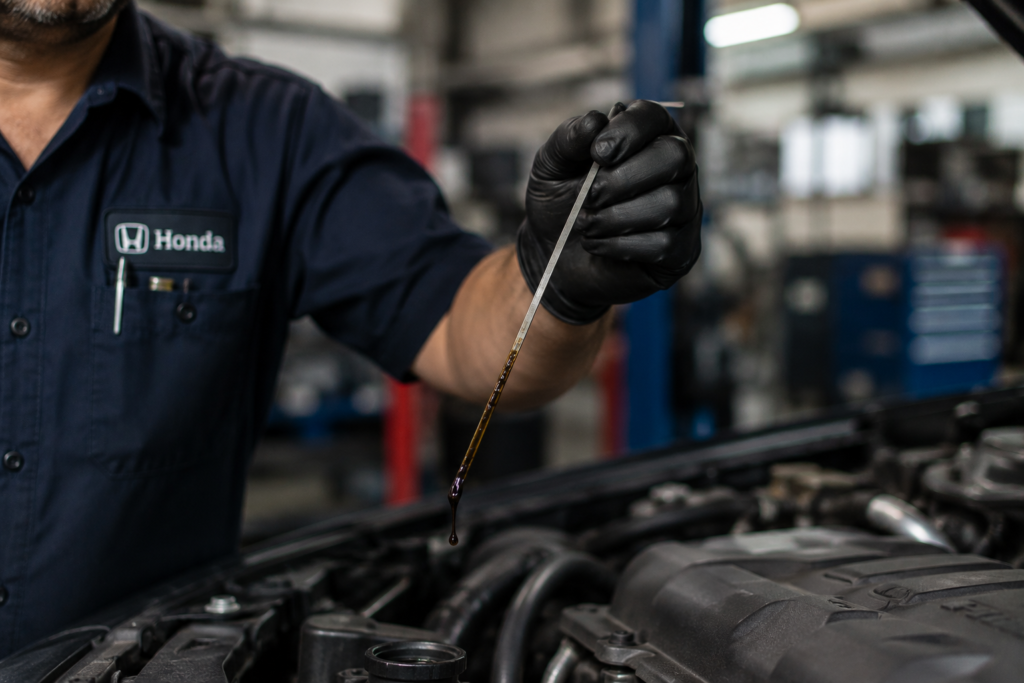
Do not wait for the dashboard light if you notice these symptoms:
- The engine sounds louder than normal, especially with a ticking or knocking noise at startup
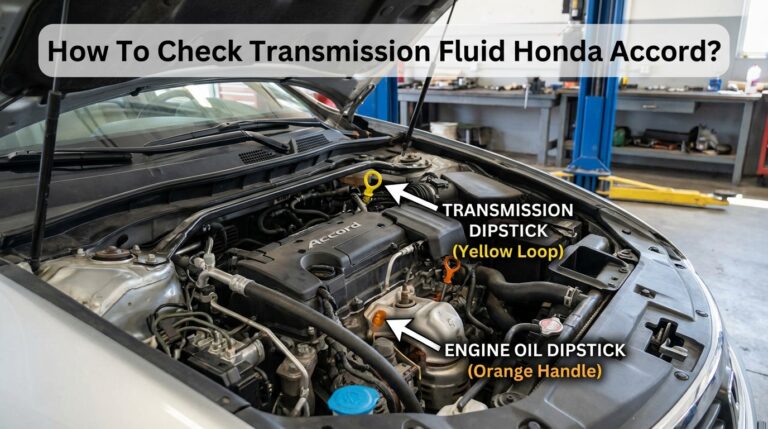
- Oil appears very dark and gritty when you check the dipstick (clean oil is amber or light brown)
- Burning oil smell inside or outside the car
- Fuel economy has dropped noticeably over recent weeks
- Rough idle or slight vibration at red lights
- The Maintenance Minder shows 15% or below
- Oil level rising on the dipstick (a common sign of fuel dilution in some turbocharged Accord engines)
Any one of these signs is reason enough to schedule an oil change, even if you are not at the usual mileage interval.
Honda Accord Oil Change Cost: What to Expect
Here is a realistic breakdown of what you will pay depending on where you go:
Costs vary by region and labor rates, but the estimates below reflect what most Accord owners can expect to pay in 2026.
| Service Location | Estimated Cost | What is Included |
| DIY (buy your own oil + filter) | $25 to $45 | Oil, filter, your time |
| Quick lube shop (Jiffy Lube, Valvoline) | $50 to $80 | Oil, filter, basic check |
| Honda dealership | $60 to $100 | Oil, filter, multi-point inspection |
| Independent mechanic | $50 to $85 | Oil, filter, varies by shop |
DIY tip: If you change your own oil, use a genuine Honda oil filter or a high-quality aftermarket equivalent. Cheap filters can reduce filtration quality and shorten oil life.
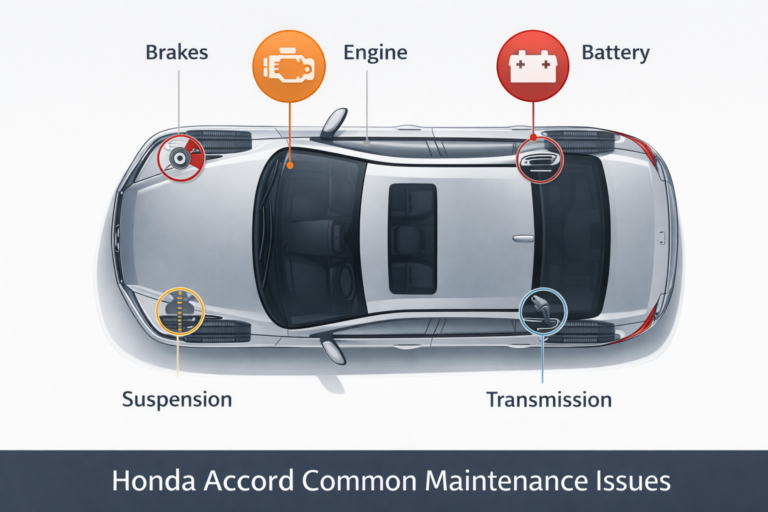
Oil changes are just the beginning; discover the most common (and expensive) maintenance issues Honda Accord owners face every year.
What Happens If You Skip Oil Changes in a Honda Accord?
This is not just theoretical. Here is what actually happens inside the engine when oil changes are neglected:
Stage 1 (Slightly overdue, 10 to 15% past due): Oil becomes slightly thicker and less effective. Fuel economy may drop by 1 to 2 MPG.
Stage 2 (Significantly overdue, 30 to 50% past due): Oil begins to sludge in low-flow areas. Engine noise increases. Oil may start burning slightly.
Stage 3 (Severely neglected 0% or beyond): Sludge blocks oil passages. Turbo bearings receive reduced lubrication. The timing chain begins to wear abnormally. At this stage, damage is already occurring.
Stage 4 (Long-term neglect over years): Major engine repairs become necessary. Timing chain replacement, turbo rebuild, or short block repair, all of which can cost $1,500 to $5,000+, depending on the extent of damage.
The worst part is that external appearance gives no clue. A Honda Accord can look brand new on the outside while the engine is suffering internally from neglected oil maintenance.
Can Oil Changes Make a Honda Accord Last Longer?
Absolutely. Regular oil changes are one of the biggest reasons many Honda Accords reach 200,000 to 300,000 miles. Clean oil protects internal engine components, reduces timing chain wear, improves turbocharger longevity, and helps maintain fuel efficiency over the long term. Skipping oil changes may save money today, but it often leads to far more expensive repairs later.
Also Read: How Reliable Is Honda Accord?
Should You Change the Oil Immediately After Buying a Used Honda Accord?
If maintenance records are incomplete or unavailable, changing the oil immediately is a smart precaution. Fresh oil establishes a known maintenance baseline and gives you a better idea of the engine’s overall condition.
FAQs
How long does Honda Accord oil last?
In most newer Accords using full synthetic oil, engine oil typically lasts 7,500 to 10,000 miles. The Maintenance Minder provides the most accurate interval based on actual driving conditions.
Should I change my Honda Accord oil every 6 months?
Not necessarily. Most modern Accords can go much longer when using synthetic oil. However, Honda recommends changing the oil at least once per year, even if the mileage is very low.
Is it okay to go 10,000 miles between oil changes on a Honda Accord?
Yes, if you have a 2013 or newer model using 0W-20 full synthetic oil and you drive mostly under normal conditions. The Maintenance Minder will confirm when the change is due. Do not push it if you do a lot of city or short-trip driving.
Can I use 5W-30 instead of 0W-20 in my Honda Accord?
Honda officially recommends 0W-20 for current Accord models. Using 5W-30 may not cause immediate damage, but it can slightly reduce fuel efficiency and may affect cold-start protection. Stick with the recommended grade.
Does the Honda Accord need a different oil change schedule in hot climates?
Yes. Extreme heat accelerates oil breakdown. If you live in a region where temperatures regularly exceed 90°F (such as Arizona, Texas, or similar climates), consider changing oil 500 to 1,000 miles earlier than the Maintenance Minder suggests, especially for 1.5T engines.
How do I reset the Maintenance Minder after an oil change?
- Turn the ignition to the On position (do not start the engine)
- Use the steering wheel controls to navigate to the Maintenance Minder on the info display
- Hold the Enter button until the system asks you to confirm the reset
- Confirm the reset
Steps can vary slightly by model year; check your owner’s manual for the exact procedure.
Should I change the oil if I drive very little (under 3,000 miles per year)?
Yes. Even with low mileage, oil degrades over time due to moisture accumulation, oxidation, and fuel contamination from cold starts. Honda recommends changing the oil at least once per year, regardless of mileage, if you drive infrequently.
What happens if the Honda Accord oil life reaches 0%?
A 0% oil-life reading means the engine oil has reached the end of its calculated service life. The vehicle may continue to run, but Honda recommends changing the oil as soon as possible to avoid accelerated engine wear.
Conclusion
The Honda Accord can easily exceed 200,000 miles, but only if routine maintenance is not ignored. Regular oil changes remain the single most important service for protecting the engine and maximizing long-term reliability. Oil changes are the single most important service you can perform, and they are also the easiest to overlook. If you are buying a used Accord, oil change records are among the strongest indicators of how well the vehicle was maintained.
For newer Accords: trust the Maintenance Minder, use 0W-20 full synthetic, and do not let it go past 0%. For older models: stick to the 5,000 to 7,500-mile schedule or shift to synthetic if you have not already.
Consistent oil changes will help your Accord reach 200,000 miles or more without major engine issues. It is one of the lowest-cost investments you can make to protect one of your most valuable assets.
Sources
- Honda Accord Owner’s Manuals (2013 to 2026)
- Honda Maintenance Minder Documentation
- American Automobile Association (AAA) Maintenance Guidelines
- NHTSA Vehicle Owner Resources