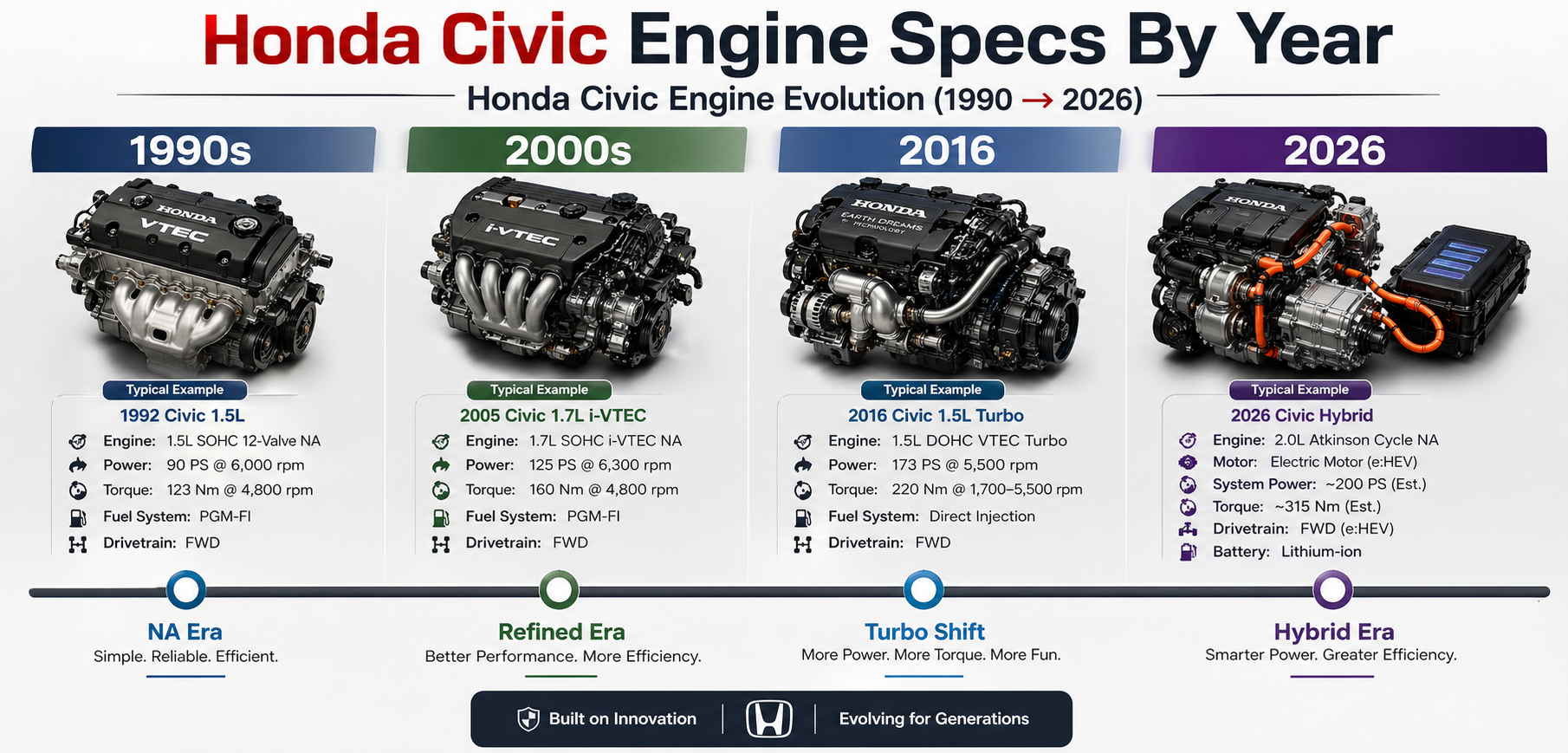
Honda Civic Engine Specs By Year (Complete Breakdown 1990 to 2026)
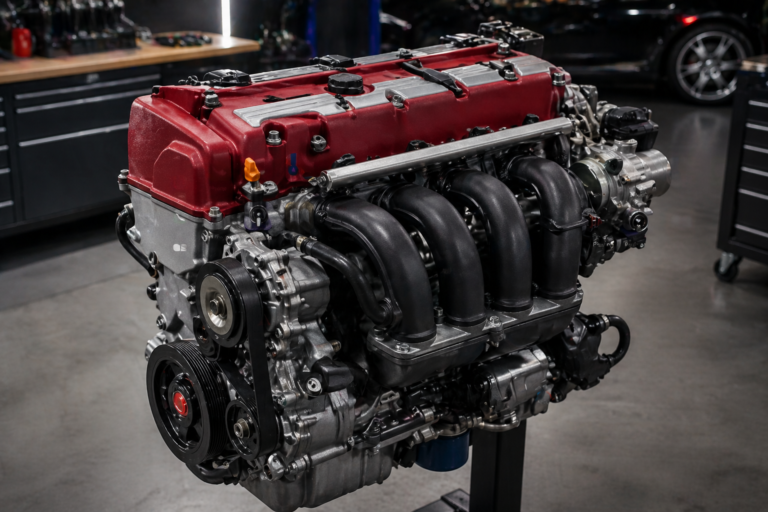
A Honda Civic comes with a 2.0L naturally aspirated engine, a 1.5L turbocharged engine, or a hybrid system in newer models. The exact engine depends on the model year, trim level, and whether the Civic is designed for efficiency, performance, or daily driving use.
Read Our Guide On: What Engine Does A Honda Civic Have?
In this guide, you will see Honda Civic engine specs by year, from 1990 to 2026, with real insights on performance, reliability, and what actually matters when choosing one.
What Engine Does a Honda Civic Have by Year?
Honda Civic engines have changed a lot over time. Older models used simple naturally aspirated VTEC engines. In 2016, turbo engines were introduced to improve power. Newer models (2022 to 2026) now include hybrid systems focused on fuel economy and smoother driving. The engine you get depends heavily on the model year and trim.
In real ownership, most drivers never push their engine hard enough to notice big differences. The 2.0L feels slow on paper, but for daily traffic, it does the job without stress. The turbo only shows its advantage when you accelerate hard or drive on highways regularly.
official Honda specifications
Honda Civic Engine Specs by Year (Full Breakdown)
Here is a simplified but accurate breakdown of key engine specs across generations:
| Model Year | Engine Type | Engine Code | Horsepower | Torque | Fuel Type |
| 1990 to 1999 | 1.5L / 1.6L NA | D15, D16 | 90 to 127 hp | 98 to 107 lb-ft | Gas |
| 2000 to 2005 | 1.7L NA | D17 | 115 to 127 hp | 110 to 114 lb-ft | Gas |
| 2006 to 2011 | 1.8L NA | R18 | 140 hp | 128 lb-ft | Gas |
| 2012 to 2015 | 1.8L NA / 2.4L | R18 / K24 | 140 to 205 hp | 128 to 174 lb-ft | Gas |
| 2016 to 2021 | 2.0L NA / 1.5L Turbo | K20C2 / L15B7 | 158 to 180 hp | 138 to 177 lb-ft | Gas |
| 2022 to 2024 | 2.0L NA / 1.5L Turbo | K20C2 / L15B7 | 158 to 180 hp | 138 to 177 lb-ft | Gas |
| 2025 to 2026 | 2.0L NA / Hybrid | K20C2 / e:HEV | 158 to 200 hp | 138 to 232 lb-ft | Gas + Electric |
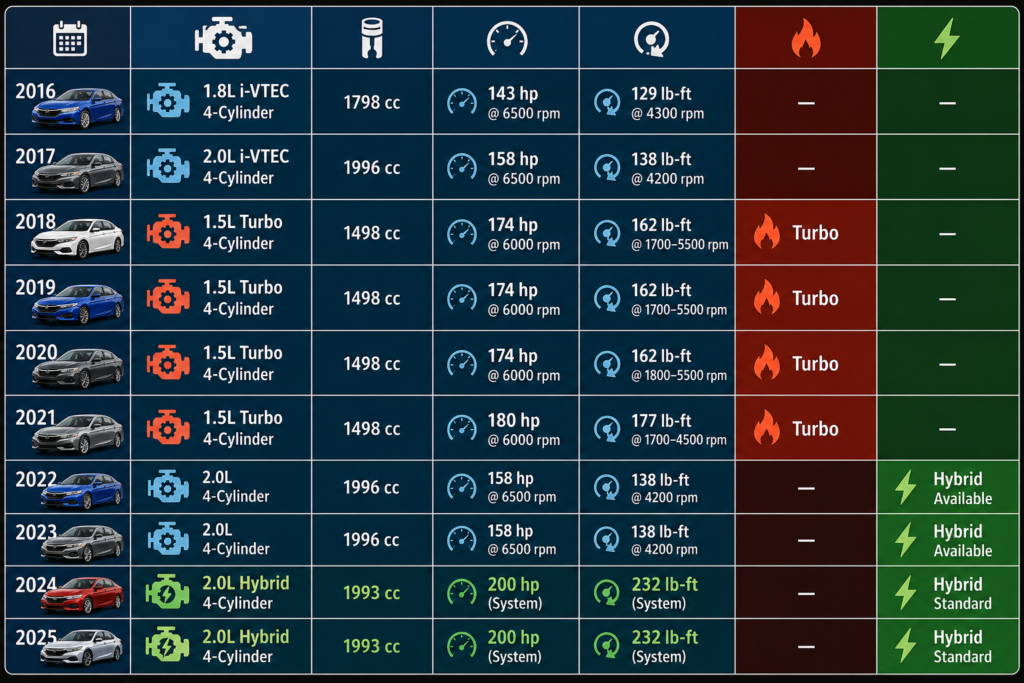
This table shows how Civic engines moved from simple NA setups to turbo and now hybrid systems.
How Honda Civic Engines Changed Over Time
1990s Civics – Simple VTEC Engines
Basic engines focused on reliability rather than speed. Easy to maintain and cheap to fix.
2000 to 2015 – Improved Efficiency and Refinement
Engines became smoother and more fuel-efficient. Power increased slightly, but still simple.
2016 to 2021 – Turbocharged Engines Introduced
The 1.5L turbo added better acceleration and highway performance. Big shift in driving feel.
2022 to 2026 – Hybrid and Modern Powertrains
Hybrid systems added for better fuel economy. Driving became quieter and smoother.
The hybrid does not feel like a typical engine setup. In city driving, it runs smoother and quieter, almost like an electric car at low speeds. But if you expect strong acceleration like a turbo, you will be disappointed. It is built for efficiency, not excitement.
For most drivers, the hybrid feels better in traffic, but less exciting when you push the car.
Most Common Honda Civic Engine Types Explained
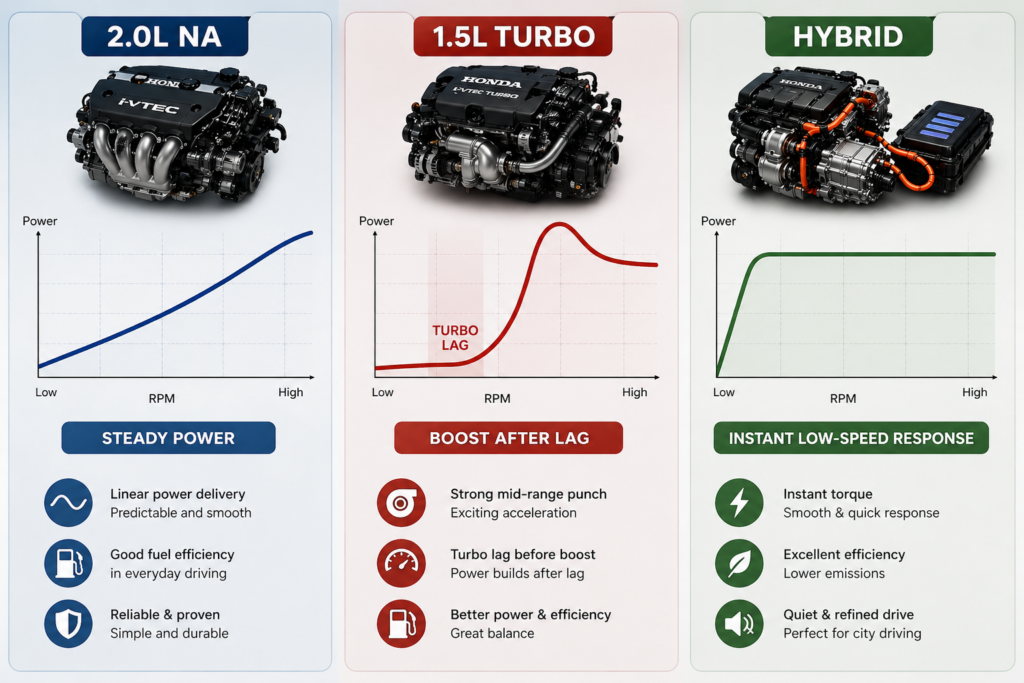
Most Civic engines are paired with a CVT transmission, which focuses on smooth power delivery instead of aggressive shifting. This is why the car feels linear rather than sporty, even with a turbo.
2.0L Naturally Aspirated Engine (K20C2)
In real use, this is the engine most owners never complain about. It just works without demanding much attention.
1.5L Turbocharged Engine (L15B7)
Feels quicker during overtaking and highway driving.
2.0L Turbo Engine (Type R – K20C1)
High-performance engine built for speed. Used in Type R, not regular Civic trims.
2.0L Hybrid Powertrain (e: HEV system)
Combines engine and electric motors. Focuses on fuel savings and quiet driving.
Honda Civic Horsepower by Year (Quick Comparison)
Power has increased steadily over time. Older Civics stayed under 130 hp, while modern ones go much higher.
| Generation | Lowest HP | Highest HP |
| 1990s | 90 hp | 127 hp |
| 2000s | 115 hp | 140 hp |
| 2010s | 140 hp | 180 hp |
| 2020s | 158 hp | 315 hp (Type R) |
Real growth came after turbo engines were introduced.
Fuel Economy Trends by Civic Engine (MPG by Year)
Fuel economy has improved across generations, especially with the introduction of hybrid models. Real-world fuel economy data also aligns closely with EPA estimates for newer Civic models.
EPA fuel economy estimates
Older vs Modern MPG Comparison
- Older models: 25 to 30 mpg
- Modern gas engines: 30 to 38 mpg
- Hybrid models: 45 to 50 mpg
Hybrid vs Gas Engine Efficiency
Hybrid models clearly lead in fuel savings. In city driving, the difference is noticeable.
Which Honda Civic Engine Is the Most Reliable by Year?
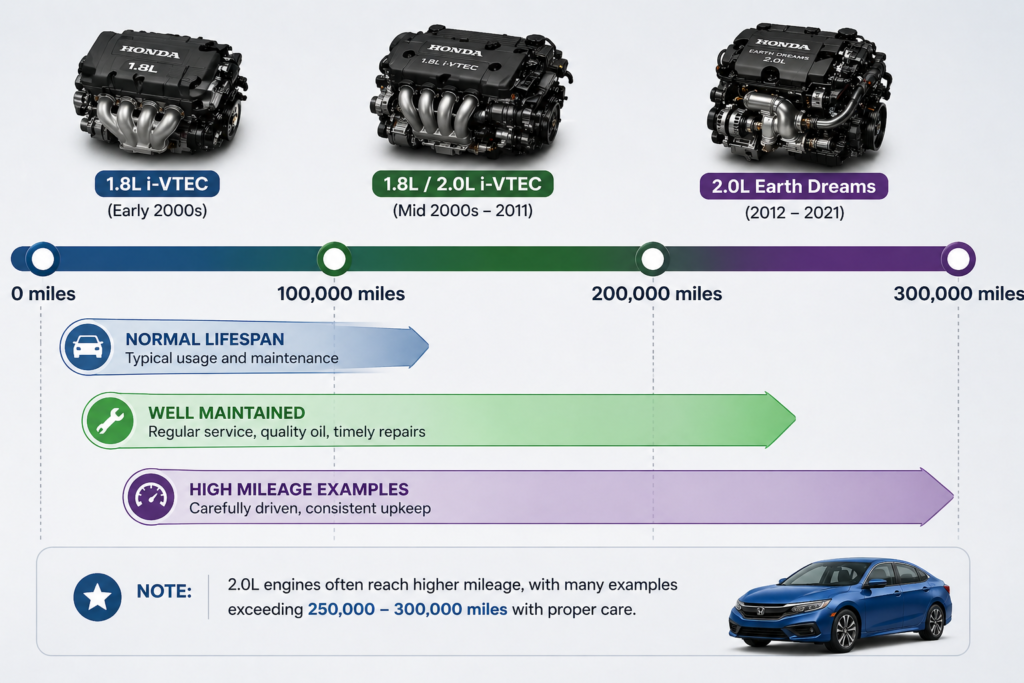
From a long-term ownership perspective, simpler engines usually age better. Turbo engines are not bad, but they depend more on maintenance discipline. Skip oil changes, and problems show up faster.
If you are thinking long term, this breakdown explains real lifespan expectations. How Many Miles Can a Honda Civic Last?
Most Reliable Older Engines
- D-series (1990s)
- R18 (2006 to 2015)
These engines are known to run long with basic maintenance.
Most Reliable Modern Engines
- 2.0L K20C2
A simple design makes it easier to maintain over time.
Engines to Be Careful With
- Early 1.5L turbo (2016 to 2019)
Minor oil dilution issues in some conditions.
Common Problems by Engine Type and Year
Oil Dilution in 1.5L Turbo (2016 to 2019)
Cold weather caused fuel mixing with oil in early models.
Carbon Buildup in Turbo Engines
Happens over time if maintenance is delayed.
General Wear Issues in High-Mileage Civics
Older engines may face leaks, worn seals, or reduced efficiency.
Best Honda Civic Engine for Your Needs
Most people overthink engine choice. If you just want a stress-free car, the 2.0L is enough for 90% of drivers. In real life, most Civic owners care more about reliability and fuel cost than speed after a few months of driving.
If you are comparing options, this guide makes the differences clearer: What Engine Does a Honda Accord Have?
Best for Daily Driving
If you want a car that just runs without surprises, this is the safest choice.
Best for Performance
If you actually enjoy driving and not just commuting, the turbo makes a noticeable difference, especially on highways.
Best for Fuel Economy
If fuel cost is your top concern, the hybrid is the only option that truly changes your monthly expenses.
Honda Civic Engine vs Honda Accord Engine
| Factor | Civic | Accord |
| Engine Size | Smaller | Larger |
| Power | Moderate | Higher |
| Use Case | Daily driving | Comfort + power |
Accord engines are stronger, but Civic engines are more efficient.
FAQs
What engine is in a 2026 Honda Civic?
The 2026 Civic offers a 2.0L engine or a hybrid powertrain, depending on the trim.
Which Honda Civic engine is best?
The best engine depends on use. 2.0L is best for daily use, while the turbo is better for performance.
Do all Honda Civics have VTEC?
Most older Civics use VTEC, but newer engines use updated versions with better efficiency.
When did Civic start using turbo engines?
Turbo engines were introduced in 2016 models.
How long do Civic engines last?
With proper maintenance, many Civic engines last over 200,000 miles.
Does the Honda Civic have a hybrid engine?
Yes, newer models include a hybrid system focused on fuel efficiency.
Conclusion
Honda Civic engines have evolved from simple VTEC setups to advanced turbo and hybrid systems. Each generation improved in efficiency, performance, and driving comfort. Honda Civic engines have evolved from simple VTEC setups to modern turbo and hybrid systems. Each generation improved in efficiency, performance, and daily usability. Most people focus on specs, but in real driving, your routine matters more than numbers. Choose the engine that fits how you actually drive, not what looks better on paper.
The Honda Civic Engine Specs By Year shows that real-world usage matters more than numbers when picking the right engine.