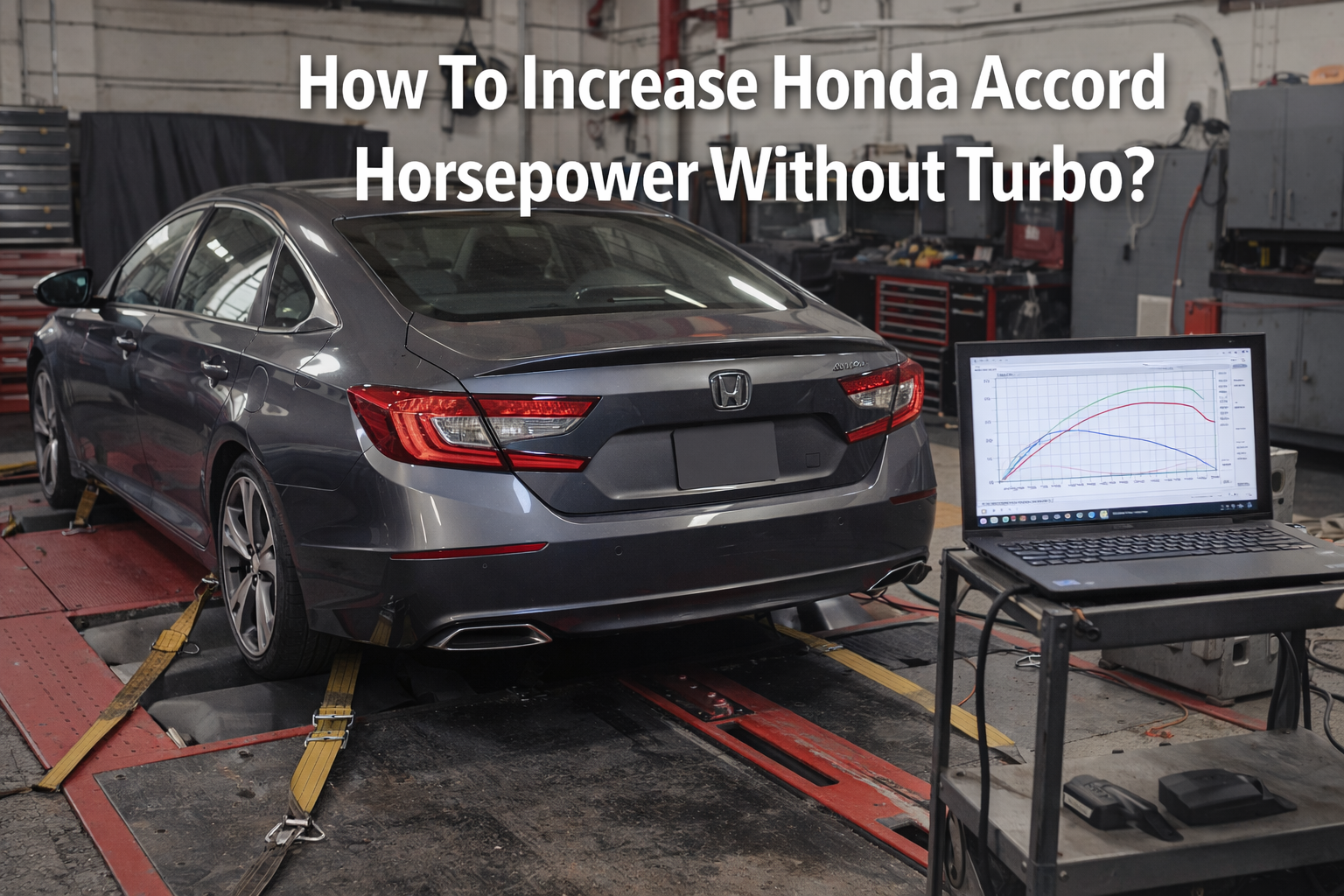
How To Increase Honda Accord Horsepower Without Turbo? Full Guide!
Naturally aspirated engines do not produce huge power jumps like turbo engines. Most owners misunderstand this and expect unrealistic gains from simple bolt-ons. In reality, small improvements in airflow, tuning, and engine efficiency create smoother acceleration, stronger mid-range pull, and more usable real-world performance.
This guide explains How To Increase Honda Accord Horsepower Without Turbo, what actually works, what does not, and how to increase Honda Accord horsepower safely without a turbo.
How Horsepower Works in the Honda Accord?
Horsepower is the engine’s ability to do work over time. More air + more fuel + clean combustion = more power. When airflow improves and friction drops, the engine produces a stronger force and better acceleration.
Curious about your Accord’s engine setup? Find out if it’s a timing belt or chain it affects performance and upgrades!
Also Read: Do Honda Accords Have Timing Belts Or Chains?
Why Naturally Aspirated Gains Plateau
Naturally aspirated engines rely only on atmospheric pressure to fill the cylinders with air. Once intake and exhaust airflow improve, additional bolt-ons produce smaller gains because the engine cannot force more air inside like a turbocharged setup. This is why most naturally aspirated Honda Accord builds reach a performance ceiling after basic airflow and tuning upgrades. The key is optimizing efficiency rather than chasing unrealistic horsepower numbers.
Air, Fuel, and Combustion Relationship:
An engine makes power by mixing air and fuel, then igniting that mixture inside the cylinder. The better this process works, the more horsepower the engine can produce.
- More air = more oxygen available for combustion
- More fuel (in the correct ratio) = stronger explosion
- Efficient combustion = maximum energy converted into power
If airflow improves through a better intake or exhaust system, the engine can burn fuel more efficiently. However, the air-fuel ratio must stay balanced. Too much fuel or too little air reduces performance and efficiency.
In simple terms: better breathing + proper tuning = more usable power.
In real driving, this usually feels like smoother pickup from 40 to 80 km/h rather than dramatic speed jumps. Many drivers notice the engine feels less strained during overtakes.
Horsepower vs Torque:
Horsepower and torque are related, but they are not the same.
- Torque is the twisting force that moves the car from a stop.
- Horsepower measures how fast that torque is delivered over time.
Torque helps your Accord feel strong at low speeds. Horsepower determines how fast the car can keep accelerating at higher speeds.
For daily driving:
- More torque = better pull from low RPM
- More horsepower = better top-end performance
Both matter. Focusing only on horsepower without understanding torque can give unrealistic expectations.
How Much Horsepower Can You Gain Without a Turbo?
Without a turbo, gains come from airflow, tuning, and efficiency. Realistically, bolt-ons can add noticeable but limited power.
| Setup Level | Expected HP Gain |
| Basic mods (intake + plugs) | 8 to 18 HP |
| Intake + exhaust | 15 to 30 HP |
| Full bolt-ons + tune | 30 to 60 HP |
These are safe, realistic numbers for most Accord engines.
On a dyno, gains often look higher than what you feel on the road. Heat, fuel quality, and road load reduce real-world performance slightly, which is normal for naturally aspirated engines.
Realistic Bolt-On Power Gains:
Bolt-on mods improve airflow and efficiency without opening the engine.
Here’s what most Honda Accord owners can realistically expect:
- Cold air intake: 5–12 HP
- Cat-back exhaust: 7–15 HP
- ECU tune (NA engine): 10–25 HP
- Full bolt-on setup with tune: 25–50 HP
These gains depend on:
- Engine type
- Fuel quality
- Tuning quality
- Overall engine health
Do not expect massive power increases without forced induction. Naturally aspirated engines have limits.
Crank Horsepower vs Wheel Horsepower:
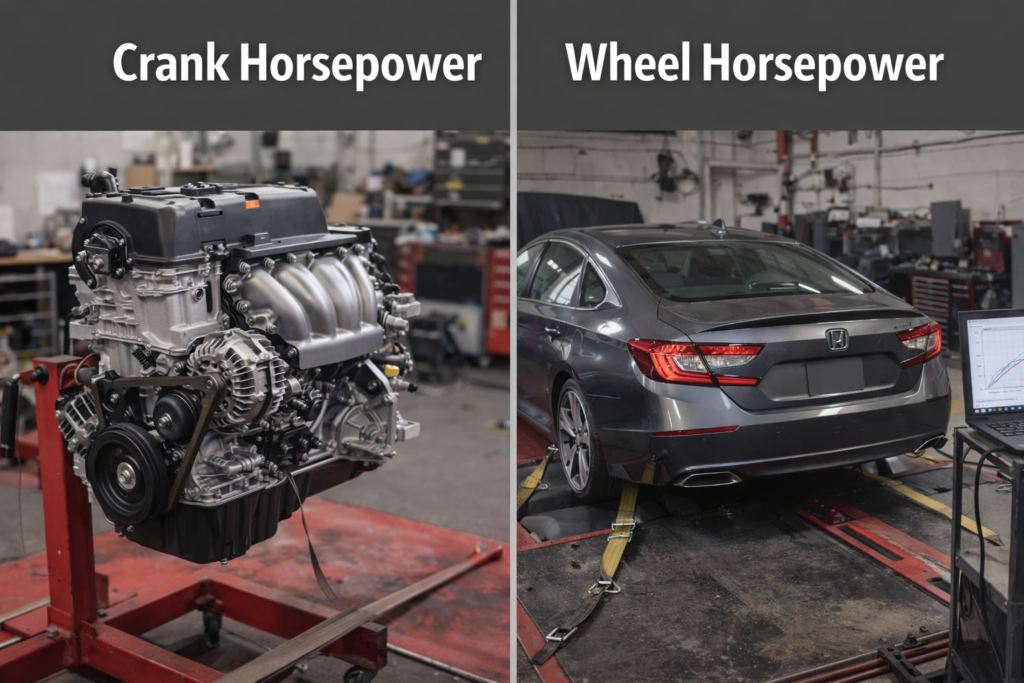
This is very important for understanding real performance numbers.
- Crank horsepower (HP) is measured at the engine.
- Wheel horsepower (WHP) is measured at the wheels on a dyno.
Because of drivetrain loss (transmission, CVT, axles), wheel horsepower is usually 10–20% lower than crank horsepower.
Example:
If your Accord makes 200 HP at the crank, it may show around 170–180 WHP.
Most online claims use crank numbers. Real-world performance feels closer to wheel horsepower.
Best Honda Accord Engines for Non-Turbo Power Gains
Some Accord engines respond better because of airflow design and tuning potential.
- 2.4L K24 (Naturally Aspirated) – Best response, strong gains with intake, exhaust, tune
- 2.0T Engine – Already turbocharged, small bolt-on gains without turbo changes
- 3.5L V6 – Good gains, especially with intake + exhaust + tune
K24 usually gives the best non-turbo improvement.
Planning upgrades? See which trims have features like Blind Spot Detection before choosing an Accord engine.
You may also like to read: Which Honda Accord Has Blind Spot Detection?
2.4L K24 Naturally Aspirated:
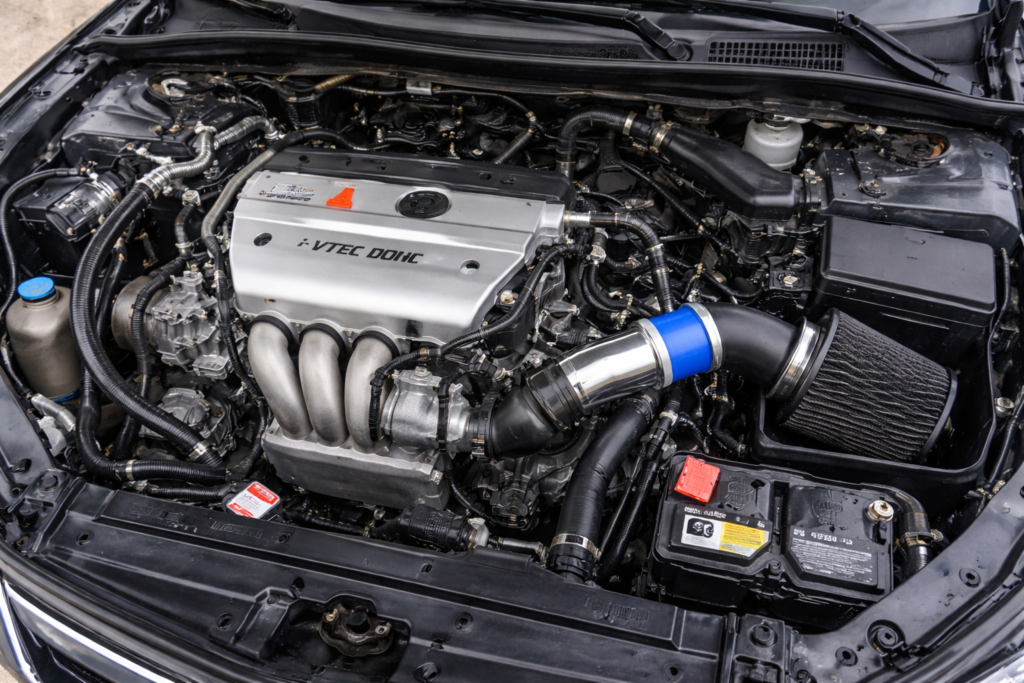
The K24 engine responds very well to bolt-on modifications.
Why it performs well:
- Strong airflow design
- Good factory compression
- Large aftermarket support
With intake, exhaust, and a proper tune, gains of 30–50 HP are possible safely. This engine is one of the best Honda platforms for naturally aspirated upgrades.
For non-turbo builds, K24 is usually the best option.
The K24 responds well because its intake airflow design and cam profile allow better breathing at mid and high RPM. Even small airflow improvements show measurable gains compared to many other naturally aspirated engines in this class.
3.5L V6:
The 3.5L V6 offers strong torque from the factory.
Advantages:
- Higher displacement
- Strong mid-range power
- Smooth acceleration
Bolt-ons and tuning can add noticeable improvements, especially in throttle response. Gains are usually moderate, but the driving feel improves significantly.
The V6 is good for daily power, but aftermarket support is slightly smaller compared to K-series engines.
2.0T Engine: (Limited Gains Without Turbo Changes)
The 2.0T is already turbocharged from the factory.
Without upgrading the turbo:
- Intake and exhaust gains are small
- Tuning gives the biggest improvement
Most serious gains on the 2.0T come from turbo upgrades or higher boost tuning. If you avoid turbo changes, improvements will be limited compared to naturally aspirated builds.
Reference Honda’s official updates for 2026 models: Honda News.
Do Cold Air Intakes Actually Increase HP?
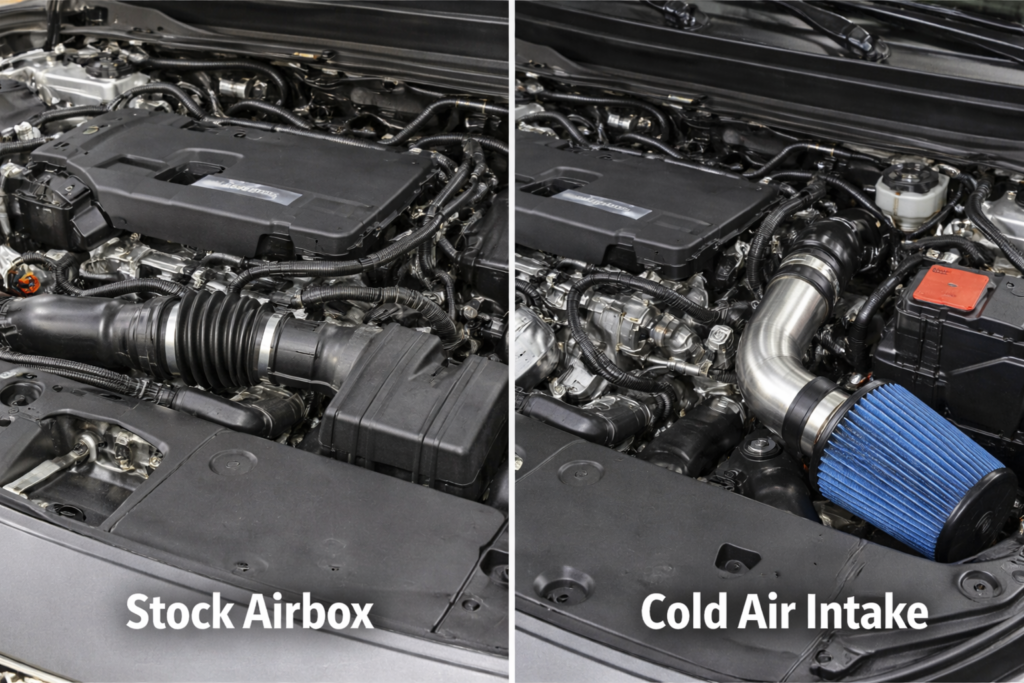
Yes, but modestly. A cold air intake brings cooler, denser air into the engine, which improves burn efficiency and throttle response.
- Typical gain: 5 to 12 HP
- Better engine breathing
- Slightly faster acceleration
Cheap intakes give weak results; quality matters.
Is a Cat-Back Exhaust Worth It Without a Turbo?
Yes, if your goal is smoother airflow and a small horsepower gain. It would not transform the car, but it improves engine breathing and response.
| Benefit | Result |
| Reduced back pressure | Better airflow |
| Faster exhaust flow | Slight HP gain |
| Sportier sound | Driving feel improves |
Expect 7–15 HP, not miracles.
ECU Tuning for Honda Accord (NA Engines)
Yes, when done properly. ECU tuning adjusts fuel, ignition timing, and throttle behavior to unlock hidden performance safely.
- Gain: 10–25 HP (NA engines)
- Faster throttle response
- Better power delivery
Avoid aggressive or cheap tunes.
After tuning, make sure your oil life indicator is accurate. Here is how to reset it safely.
Also Read: How to Reset Oil Life on Honda Accord?
Is It Safe for Daily Driving?
Yes, if modifications are done correctly.
Safe daily setup includes:
- Quality cold air intake
- Cat-back exhaust
- Professional ECU tune
- Regular maintenance
Avoid:
- Aggressive tuning
- Poor-quality parts
- Cheap plug-and-play power chips
A balanced setup keeps reliability close to factory levels while improving performance.
CVT vs Manual Differences:
Transmission type matters when adding power.
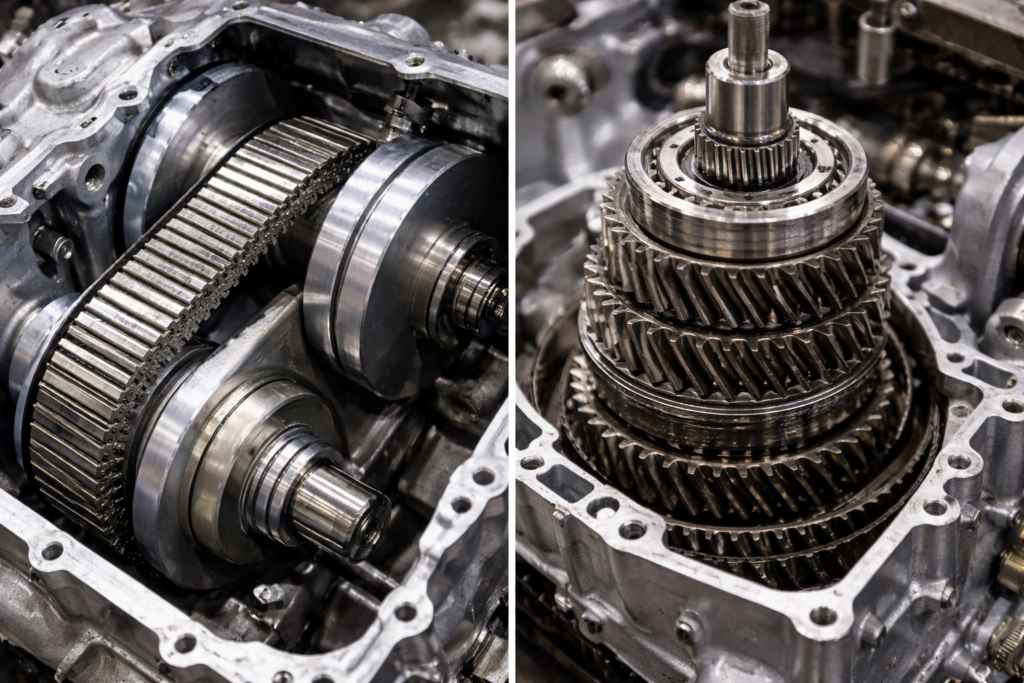
CVT (Continuously Variable Transmission)
- Prefers smooth power delivery
- Sensitive to sudden torque spikes
- Best with mild tune and bolt-ons
Manual Transmission
- Handles power increases better
- More durable for aggressive driving
- Better control over RPM and torque
If your Accord has a CVT, focus on moderate gains and smooth tuning. Manuals allow more flexibility.
Can You Increase Power Safely on a CVT Accord?
Yes, but keep it moderate. CVT transmissions prefer smooth torque, not aggressive power spikes.
- Safe mods: intake, plugs, mild tune
- Avoid heavy torque mods
- Keep transmission fluid fresh
Focus on smooth power, not peak numbers.
Do Lightweight Wheels Improve Acceleration?
Yes. Lighter wheels reduce rotational mass, meaning the engine works less to spin them.
- Faster acceleration feel
- Better handling response
- Slight fuel efficiency improvement
Not horsepower, but real performance gain.
Should You Upgrade Suspension for Better Speed?
Suspension does not add horsepower, but it helps you use power more effectively. Better grip, faster real-world speed.
- Improved cornering stability
- Better tire contact with the road
- More controlled acceleration
Useful for performance driving, not power increase.
Do Brake Upgrades Improve Performance?
Brakes do not increase speed, but they improve control and confidence. Better stopping lets you drive faster, safely.
| Upgrade | Benefit |
| Performance pads | Shorter stopping distance |
| Better rotors | Heat control |
| Steel brake lines | Firmer pedal feel |
Performance is not only about acceleration control matters.
What Are the Best Mods Under $1,000?
If the budget is limited, focus on airflow and combustion.
- Cold air intake
- Performance spark plugs
- High-flow air filter
- Fuel injector cleaner + maintenance
Best budget power improvements without risk.
What Mods Should You Avoid?
Some mods waste money or reduce reliability.
- Fake electric turbo fans
- Cheap ECU chips
- Oversized heavy wheels
- Extremely loud straight pipes
If it sounds too good or too cheap, avoid it. Many drivers report smoother throttle response and more consistent power delivery after proper tuning and airflow upgrades.
Are These Mods Street Legal?
Most basic bolt-ons are street legal, but laws vary by country and region.
| Mod | Usually Legal? |
| Cold air intake | Yes |
| Cat-back exhaust | Yes (within noise limits) |
| ECU tune | Yes |
| Muffler delete | Sometimes illegal |
Always check local vehicle laws.
What Is the Best Non-Turbo Mod Setup?
The best balanced setup focuses on airflow + tuning + efficiency.
- Cold air intake
- Cat-back exhaust
- ECU tune
- Performance spark plugs
- Lightweight wheels
This combo gives the strongest safe gains without turbo.
Does Regular Maintenance Increase Horsepower?
Yes, indirectly but importantly. A healthy engine produces full factory power, while neglected engines lose performance.
- Clean filters improve airflow
- Fresh oil reduces drag
- Healthy ignition improves burn
Maintenance does not add power; it restores hidden power. In daily driving, the improvement is most noticeable in mid-range acceleration, especially during highway merging and overtaking.
Air Filter and Airflow:
A clean air filter improves airflow into the engine.
Benefits:
- Better throttle response
- Improved combustion
- Restored factory performance
A clogged filter restricts airflow and reduces power. Even simple maintenance can restore lost horsepower
Engine Oil and Friction:
Engine oil reduces internal friction between moving parts.
Fresh oil:
- Improves engine efficiency
- Reduces heat
- Maintains smooth operation
Old or dirty oil increases resistance inside the engine, which can slightly reduce performance. Regular oil changes help maintain full power output.
Spark Plugs and Combustion Efficiency:
Spark plugs ignite the air-fuel mixture.
Worn plugs can cause:
- Weak combustion
- Misfires
- Reduced acceleration
Performance or fresh OEM plugs ensure:
- Strong ignition
- Smoother engine operation
- Better fuel burn
Small upgrade, but noticeable improvement in engine response. Real performance is not defined only by peak horsepower numbers. Smooth power delivery, consistent engine response, and usable mid-range acceleration often make a bigger difference in real-world driving than chasing maximum dyno figures.
FAQ’s:
Can you increase Honda Accord horsepower without a turbo?
Yes. By improving airflow, ECU tuning, and engine efficiency, most Honda Accords can gain 10–40 HP safely without turbocharging.
Do bolt-on mods really increase horsepower?
Yes, but gains are moderate. Intake, exhaust, and tuning improve airflow and combustion efficiency, resulting in modest but noticeable power improvement.
Is ECU tuning safe for daily driving?
Yes, when done professionally. A safe tune improves throttle response and power delivery without harming engine reliability.
How much horsepower can a stock Honda Accord handle safely?
Most stock Accord engines safely handle small bolt-on gains of around 10–40 HP without reducing reliability, as long as tuning remains conservative and maintenance is up to date.
Does a cold air intake make your Honda Accord faster or just louder?
A quality cold air intake slightly improves acceleration and throttle response by improving airflow, but the horsepower gain is modest and not dramatic.
Conclusion:
Increasing Honda Accord horsepower without a turbo is possible through smart airflow upgrades, careful tuning, weight reduction, and consistent maintenance. Gains stay modest but real, improving throttle response, mid-range pull, and overall driving feel. Focus on balanced, reliable modifications, avoid risky shortcuts, and your Accord will feel stronger and smoother.