How Regenerative Braking Works in the Accord Hybrid (Hybrid Braking Explained)
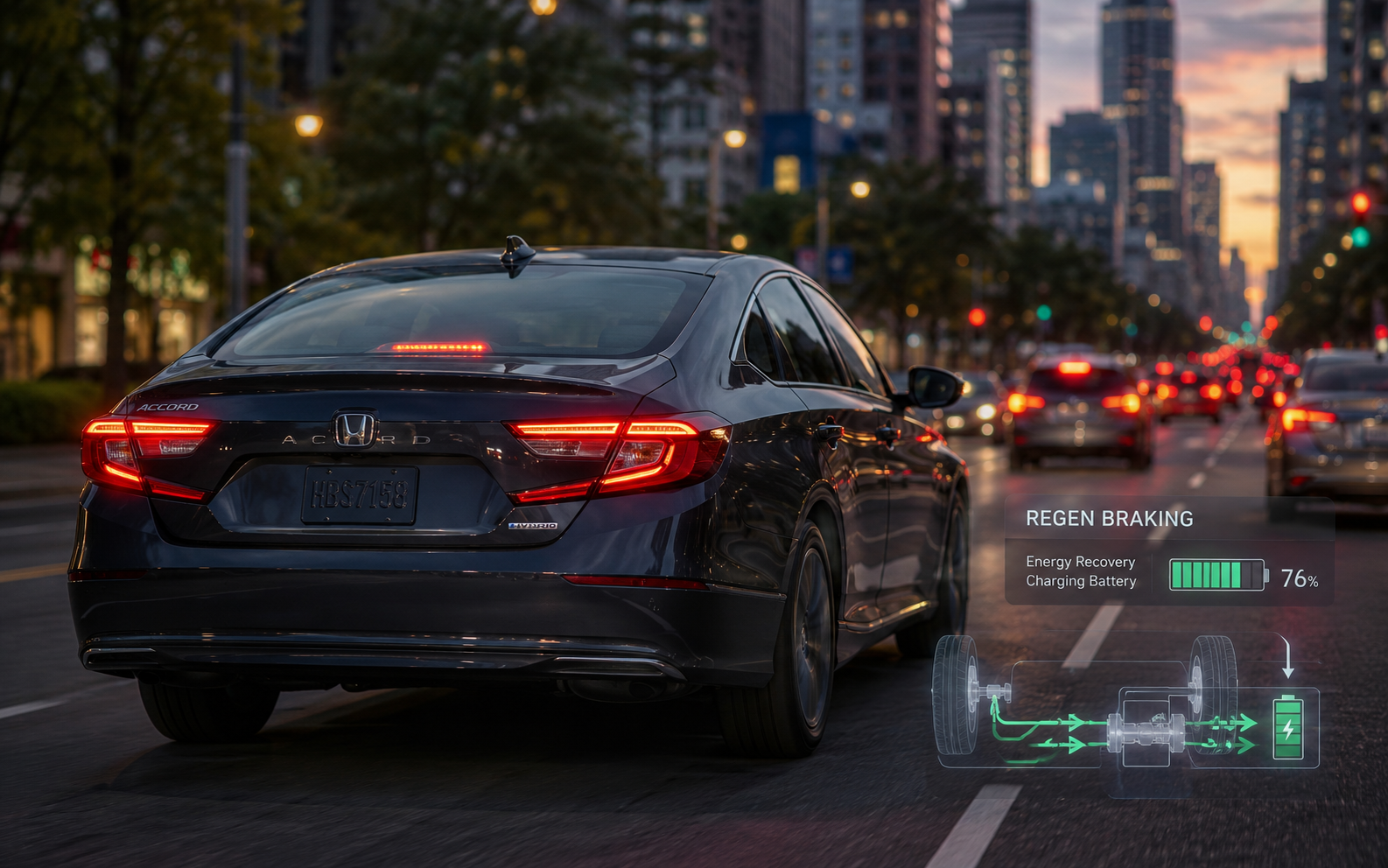
The Honda Accord Hybrid uses regenerative braking to recover energy while slowing. Instead of wasting motion as heat through brake pads, the system stores part of that energy in the high-voltage battery, improving MPG efficiency, especially in city traffic, where frequent deceleration creates more charging opportunities.
In this guide, you will learn how regenerative braking works in the Honda Accord Hybrid and why it plays a major role in improving fuel efficiency.
What Triggers Regenerative Braking?
Regenerative braking activates mainly in two situations:
- When you lift your foot off the accelerator
- When you lightly press the brake pedal
The hybrid control unit constantly decides how much stopping force should come from regenerative braking and how much should come from the traditional friction brakes.
At lighter braking levels, the car relies more on regeneration. While slowing aggressively or during emergency stops, the traditional brakes provide most of the stopping power.
The Role of the Electric Motor as a Generator
As it accelerates, the electric motor helps move the car forward. But while slowing down, the motor reverses its role and begins generating electricity instead of consuming it.
As the wheels continue spinning during coasting or braking, that movement turns the motor into a generator. The recovered electricity is temporarily stored inside the high-voltage battery so it can assist the gasoline engine later.
That stored energy helps support:
- Future acceleration
- Low-speed driving
- Engine assistance during cruising
This is one reason the Accord Hybrid performs especially well in stop-and-go traffic.
How Energy Recovery Improves Fuel Efficiency
Every time regenerative braking captures electricity, the gasoline engine has to work slightly less afterward.
The recovered electricity reduces engine workload, supports acceleration, and improves overall MPG efficiency, especially in stop-and-go traffic where hybrids perform best.
The biggest MPG efficiency improvements usually happen in:
- Urban commuting
- Heavy traffic
- Frequent stop-and-go driving
- Moderate downhill driving
Highway driving benefits less because there are fewer braking opportunities.
Also Read: How Hybrid Switches Between Engine And Motor
Blended Braking System Explained
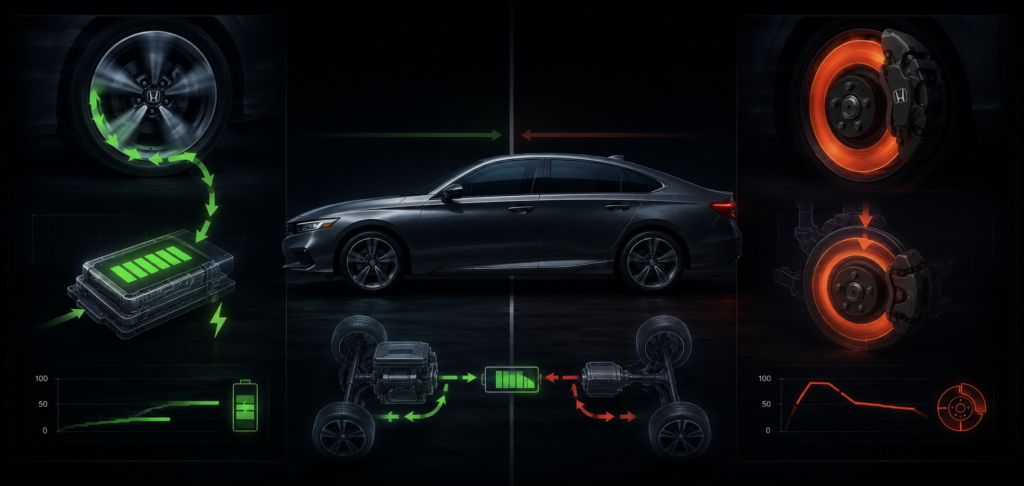
The Accord Hybrid does not rely only on regenerative braking. Instead, it uses a blended braking setup where regenerative braking and traditional friction brakes work together. The brake control computer constantly balances both systems to keep braking controlled and predictable.
At lower braking demands, regen braking handles most of the deceleration. At higher braking demands, the friction brakes add extra stopping force when needed. Most drivers never notice when the car switches between regenerative and friction braking.
Honda’s hybrid braking calibration focuses heavily on a consistent pedal feel because uneven brake transitions are one of the most common complaints in poorly tuned hybrid systems.
Why Brake Pedal Feel Stays Familiar
Honda engineers carefully tuned the braking behavior so the Accord Hybrid still feels like a regular midsize sedan. Even though regenerative braking and friction braking operate together behind the scenes, the brake pedal remains predictable in everyday driving.
Compared to some aggressive EV systems, Honda tuned the Accord Hybrid for more controlled deceleration, predictable pedal response, and a comfortable daily driving feel.
That tuning approach is one reason many drivers adapt to the Accord Hybrid quickly.
Key Components Behind Regenerative Braking
Several major components work together to make regenerative braking possible.
Electric Motor/Generator
Converts wheel movement into electricity while slowing down and powers the vehicle while accelerating.
High-Voltage Battery
Stores recovered electrical energy for short-term reuse.
Brake Control Unit
Controls how regenerative braking and friction braking operate together.
Power Control Unit
Directs electrical energy flow throughout the hybrid system.
How Regen Paddle Levels Work in the Accord Hybrid
Modern Honda Accord Hybrid models include steering-wheel regen paddles that let drivers adjust how aggressively the vehicle slows down after lifting off the accelerator.
- Pulling the left paddle increases regenerative braking strength
- Pulling the right paddle reduces regen intensity
In normal driving, the regen level usually resets after acceleration. However, some Accord Hybrid models can temporarily retain stronger regen levels, especially in Sport mode.
Stronger regen settings create more noticeable deceleration, improve downhill control, and slightly reduce brake pedal use in traffic while increasing electricity recovery during coasting.
Unlike full EV one-pedal driving systems, the Accord Hybrid still requires the brake pedal for complete stops and maintains normal creep behavior at low speeds.
What Regen Paddles Feel Like in Daily Driving?
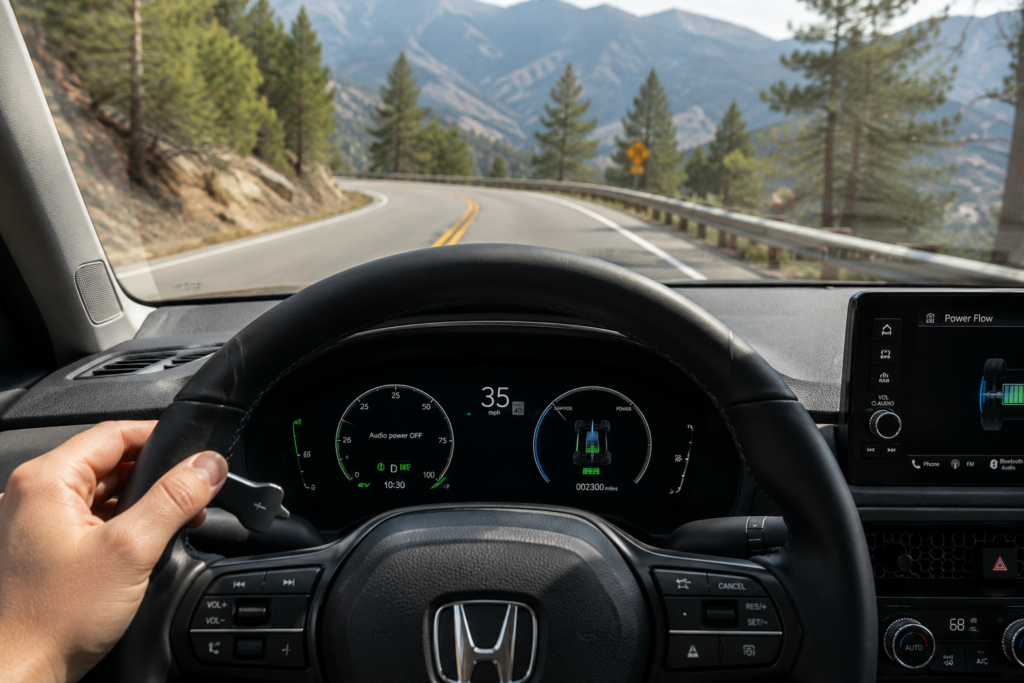
In everyday driving, stronger regen paddle settings make the Accord Hybrid slow down earlier when you lift off the accelerator. In traffic, that can slightly reduce how often you move the brake pedal.
On downhill roads, the stronger regen levels help keep speed under control without riding the brakes constantly. Most owners also notice the battery charging graphic becoming more active during longer coasting periods.
Honda intentionally tuned the system to feel balanced instead of overly aggressive, so the deceleration usually feels more familiar than full EV one-pedal driving systems.
Why Regenerative Braking Feels Different in Traffic
Many first-time Accord Hybrid drivers notice the car slows down more than expected after releasing the accelerator. That feeling comes from regenerative braking activating before the friction brakes engage.
In stop-and-go traffic, this creates:
- Smoother deceleration
- Less constant brake use
- Better electricity recovery
- Improved city MPG efficiency
Instead of wasting momentum as heat, the car recovers part of that movement and stores it in the battery.
In heavy traffic, you can actually feel the Accord Hybrid start slowing the moment you lift off the accelerator. After a few days, most drivers naturally begin timing traffic gaps differently because the car coasts less than a normal gasoline sedan.
Real-World City Driving Behavior
Regen braking performs best in urban environments where slowing happens frequently.
In everyday commuting, the Accord Hybrid feels calmer in traffic, and many drivers notice smoother stops along with less brake pedal fatigue. Frequent slowing gives the Accord Hybrid more opportunities to recover electricity.
That is why many Accord Hybrid owners achieve their best MPG during city driving rather than highway cruising.
How It Feels on Downhill Roads
On long downhill sections, stronger regen settings help slow the vehicle naturally without constant brake pedal pressure.
On longer downhill drives, many owners notice:
- Better downhill control
- Reduced brake heat buildup
- Less brake fade
- More stable speed management
On steep downhill roads, the stronger regen paddle settings can make the car feel more controlled without constantly moving your foot between the accelerator and brake pedal.
However, regenerative braking weakens once the battery becomes nearly full because the battery cannot store unlimited electricity. At that point, the Accord Hybrid then increases friction brake usage to handle more of the braking workload.
Why Regen Braking Weakens When the Battery Is Full?
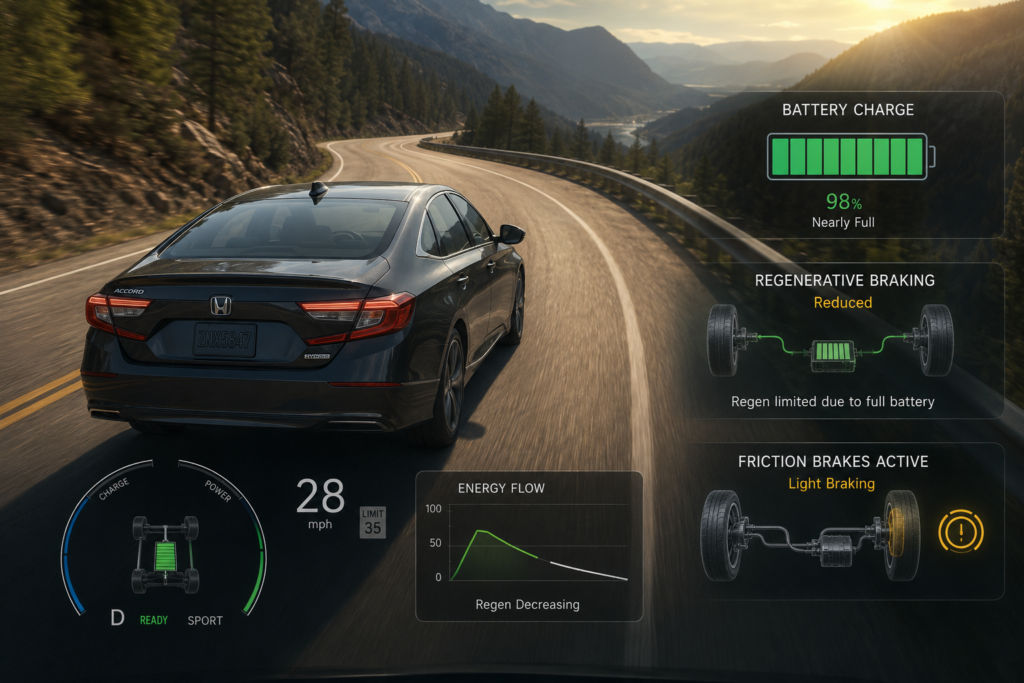
Regenerative braking depends on available battery space. If the battery is already near full charge, regen output drops to protect long-term battery health.
Under heavy downhill braking, owners may notice:
- Less deceleration during lift-off
- More traditional brake use
- Slightly different brake feel during long descents
That is completely expected. The Accord Hybrid then increases friction braking whenever regenerative braking becomes limited. This is especially noticeable after long downhill descents, where the battery charges quickly and has less room to accept additional recovered electricity.
Extreme cold temperatures can also temporarily reduce regen performance because batteries accept charge less efficiently in low temperatures.
When Regenerative Braking Is Most Effective
Regen braking performs best in stop-and-go traffic, moderate-speed commuting, gradual slowing, and downhill coasting, where the hybrid system has more opportunities to recover electricity.
Its effectiveness decreases during:
- Hard acceleration
- Full battery conditions
- Extremely cold weather
- Slippery road conditions
Safety and battery protection always take priority over maximum electricity recovery.
Does Regenerative Braking Work at Highway Speeds?
Yes, but highway regen behavior differs from city driving.
At highway speeds, the Accord Hybrid focuses more on efficient cruising than constant electricity recovery.
Regenerative braking still works during:
- Highway exits
- Traffic slowdowns
- Long downhill sections
- Gradual speed reduction
At steady highway speeds, regenerative braking mostly stays in the background. You usually notice it more while exiting the highway or slowing for traffic ahead.
However, city driving creates more frequent regen cycles, so urban environments usually produce better hybrid MPG efficiency.
Read Guide: How Many MPG Does A Honda Accord Get?
Common Signs You are Using Regen Braking
Most drivers notice slight deceleration after lifting off the accelerator, especially in traffic. The dashboard energy-flow display also becomes more active while the battery recovers electricity during slowing and coasting.
After some seat time, many owners begin using the regen paddles almost automatically in traffic or while driving downhill.
How Regen Braking Affects Brake Pad Life
Because regenerative braking handles part of the slowing process, the friction brakes are used less often. As a result, brake wear decreases over time, and many owners experience longer service intervals for brake pads and rotors compared to traditional gasoline vehicles.
Limitations and Safety Considerations
Regenerative braking cannot fully replace traditional brakes.
Emergency stops still rely heavily on friction braking because regenerative systems have limited stopping power under high-load conditions.
Regen output also drops during:
- Full battery conditions
- Slippery roads
- Extreme temperatures
These limitations help maintain vehicle stability and battery safety.
Driving Habits That Maximize Energy Recovery
Drivers can improve regen efficiency by:
- Coasting earlier before stops
- Avoiding sudden braking
- Using Eco mode when appropriate
- Using regen paddles on downhill roads
- Keeping tires properly inflated
Smooth driving creates the best electricity recovery opportunities.
Maintenance Tips for the Regen System
The regenerative braking setup requires very little direct maintenance.
Owners should:
- Follow Honda’s recommended service schedule
- Keep battery cooling vents clean
- Monitor brake system warnings
- Maintain proper tire pressure
No special maintenance is normally required for the regenerative braking hardware itself.
Honda Accord Hybrid vs Toyota Hybrid Regen Feel
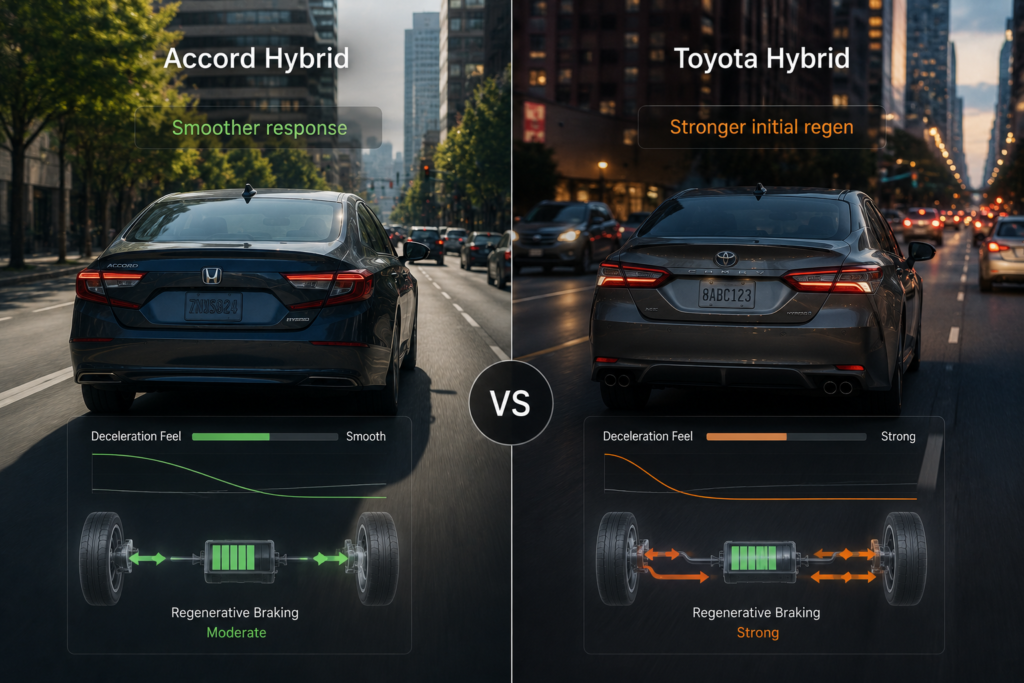
Honda and Toyota both use regenerative braking, but their systems feel slightly different in real-world driving.
Honda Regen Feel
Honda tunes the Accord Hybrid for:
- controlled braking feel
- Predictable transitions
- Familiar pedal response
- Comfortable daily driving
Many drivers describe Honda’s regen behavior as softer and easier to adapt to.
Toyota Regen Feel
Toyota hybrids often apply stronger initial regen while lifting off the accelerator.
This can feel:
- More aggressive
- More noticeable
- More hybrid-like
Toyota may recover slightly more electricity in certain situations, while Honda prioritizes a more natural driving feel. The difference mostly comes down to driving preference.
Common Myths About Regenerative Braking
Myth 1: Regenerative Braking Replaces Regular Brakes
It works alongside traditional brakes for safety and emergency stopping.
Myth 2: Regen Braking Damages the Battery
The hybrid system operates within safe charging limits designed to protect battery health.
Myth 3: Regen Braking Fully Charges the Battery
Regen provides gradual charging, but the gasoline engine still helps maintain proper battery levels.
Comparison: Regenerative vs Traditional Braking
While both braking systems slow the vehicle, regenerative braking also helps recover electricity that would otherwise be wasted as heat.
| Aspect | Regenerative Braking | Traditional Braking |
| Energy Output | Converts motion into electricity | Converts motion into heat |
| Brake Wear | Lower over time | Higher over time |
| Stopping Power | Moderate slowing assistance | Full stopping force |
| Emergency Braking | Limited by motor capacity | Handles emergency stops |
| Battery Dependency | Requires available battery space | Independent of the battery |
| Brake Fade Risk | Lower during moderate use | Higher during repeated heavy braking |
| Best Use Case | City traffic and coasting | Emergency and high-load braking |
| Efficiency Impact | Improves MPG efficiency | No energy recovery |
How This Affects Real-World Driving Experience
In daily driving, regenerative braking mostly works quietly in the background.
Most owners quickly notice:
- Quieter deceleration
- Smoother traffic behavior
- Fewer brake service visits
- Better city MPG efficiency
The feature feels especially useful in:
- Heavy traffic
- Urban commuting
- Long downhill driving
- Moderate coasting situations
Most drivers adapt to the different driving feel within a few days.
Can Regenerative Braking Charge the Accord Hybrid Battery Fully?
Regenerative braking helps recharge the hybrid battery gradually during normal driving, but it usually does not fully charge the battery by itself. The gasoline engine still works with the hybrid system to maintain proper battery levels.
Long downhill roads and heavy stop-and-go traffic create the most charging opportunities because the car slows down more often. However, Honda limits battery charging levels to protect long-term battery health and system reliability.
FAQs
Can regenerative braking fully stop the Accord Hybrid?
No. The system slows the car down but still relies on friction brakes for complete stops.
Does regenerative braking work in all weather conditions?
Yes, but regen output may decrease in icy or extremely cold conditions for safety reasons.
Why does the Accord Hybrid slow down when I lift off the accelerator?
The electric motor switches into generator mode and begins recovering electricity, which creates natural deceleration.
Does regenerative braking work in Sport mode?
Yes. Many Accord Hybrid models allow stronger retained regen levels in Sport mode.
Can regenerative braking overheat?
Under normal driving conditions, overheating is very unlikely because the Accord Hybrid constantly manages temperature and electrical flow automatically.
Does regenerative braking reduce brake replacement costs?
Yes. Reduced friction brake usage often helps extend brake pad and rotor life.
Conclusion
Regenerative braking is one of the biggest reasons the Accord Hybrid feels so efficient in daily driving. Instead of wasting energy every time the car slows down, the hybrid system recovers part of that motion and stores it for later use.
In real-world traffic, the result is quieter deceleration, reduced brake wear, and better MPG without requiring special driving techniques. Features like regen paddles and blended braking also help the Accord Hybrid feel more comfortable and easier to drive in daily traffic than many people expect from a hybrid sedan.
While regenerative braking cannot fully replace traditional brakes, it plays a major role in how the Accord Hybrid balances efficiency, comfort, and everyday usability.