How Hybrid Switches Between Engine and Motor (Explained Simply)
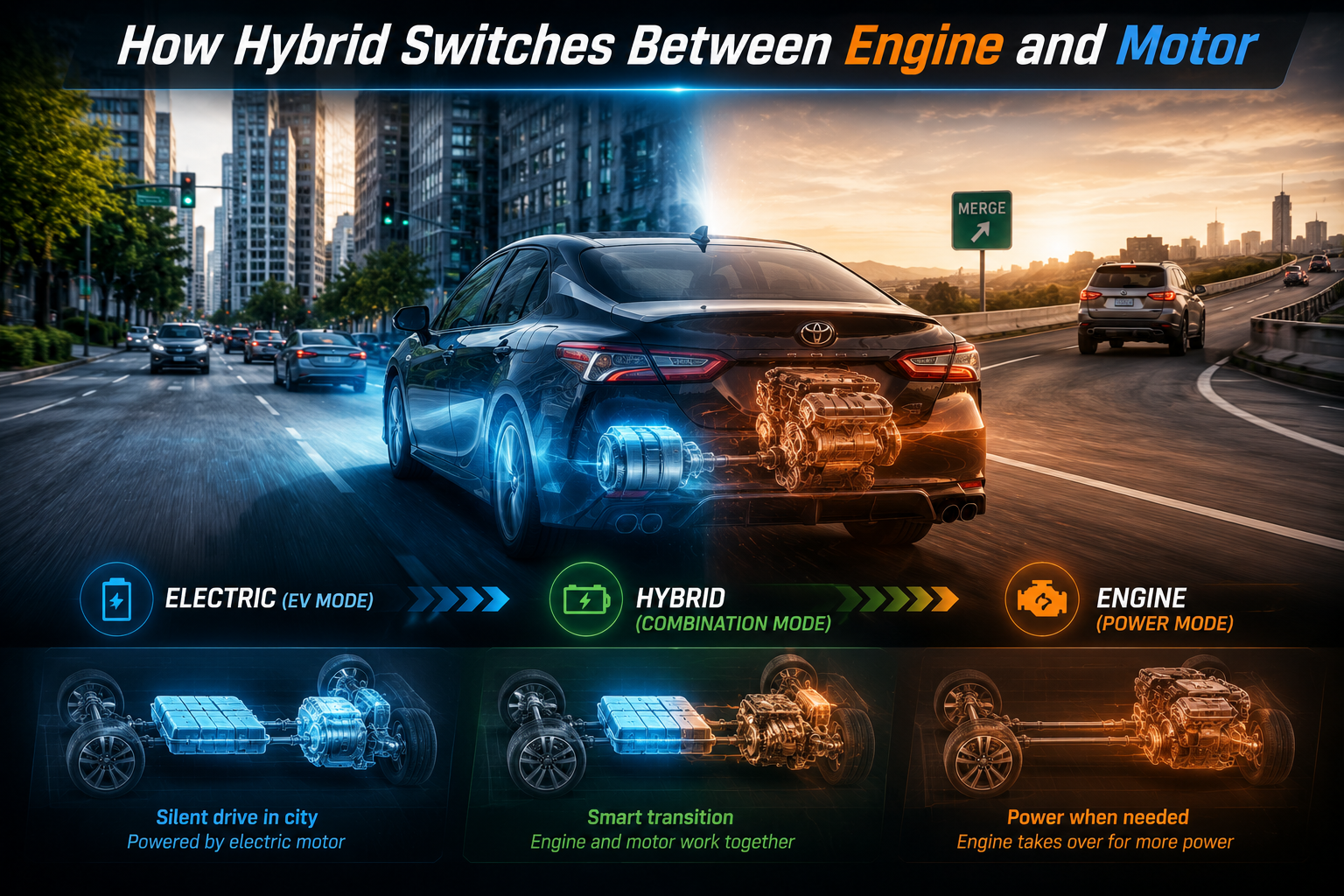
Today’s hybrids do not switch randomly. The system constantly checks speed, battery charge, road load, throttle input, and driving conditions to decide whether the electric motor, gasoline engine, or both should work together. Recent Toyota, Honda, Hyundai, and Ford hybrids react faster than older models and can change power sources in milliseconds without the driver noticing.
In real driving, the switch usually feels invisible. The car may move silently in traffic one moment, then start the engine seconds later during acceleration or highway merging.
How Does a Hybrid Decide Between Engine and Motor?
If you have ever driven a hybrid in traffic, you may notice it behaves differently depending on how hard you press the accelerator. Behind that behavior is a control computer called the Hybrid Control Unit. speed, acceleration, road angle, and engine load to pick the most efficient power source.
In most cases, many Toyota hybrids stay in EV mode longer during parking lot driving, but the engine may start quickly once the driver presses the pedal harder.
Older hybrids mostly relied on speed. Recent models also predict driver behavior. If the car senses quick throttle movement or uphill driving, it may start the engine early to avoid battery strain.
| Driving Situation | Most Likely Power Source |
| Slow city driving | Electric motor |
| Heavy acceleration | Engine + motor |
| Highway cruising | Mostly engine |
| Stop-and-go traffic | Electric motor |
| Low battery level | The engine charges the battery |
What Triggers a Hybrid to Switch Power Sources?
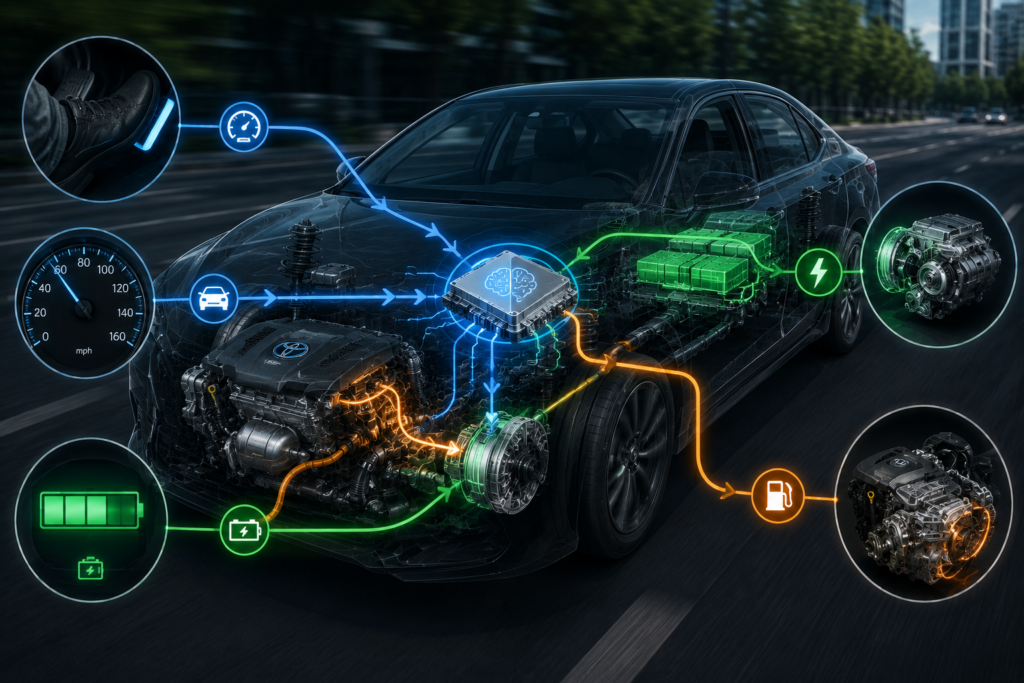
In real driving, hybrid switching is not something you directly notice because it happens automatically in the background. The system is constantly adjusting based on driving demand rather than just speed alone, which is a common misconception.
A strong press on the accelerator can quickly activate the engine to provide extra power. If the battery charge drops below a certain level, the engine may also start to recharge it. During highway driving, the system often relies more on the engine for steady efficiency, while in cold weather, it may keep the engine running longer to support heating and protect battery performance. All these decisions happen in real time without driver input.
Why Hybrids Switch Faster Today?
Some recent hybrid models can predict extra power demand before the driver fully accelerates. The system studies throttle pressure and wheel load before the power demand fully increases. This helps reduce lag and improve fuel economy, which depends on driving style in real traffic.
When Does the Electric Motor Take Over?
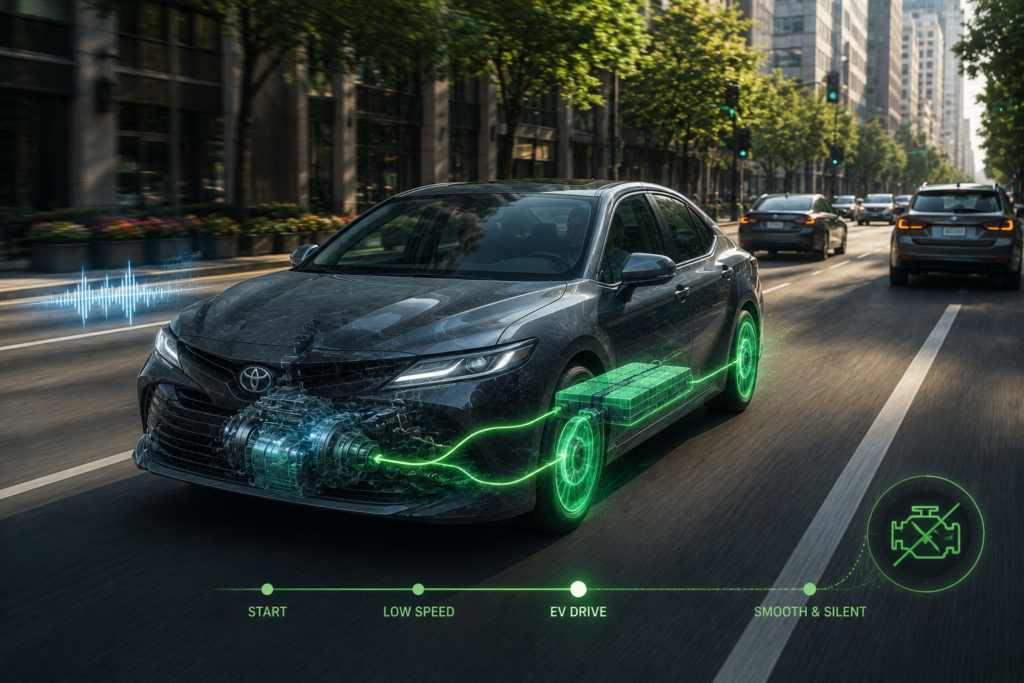
The electric motor mainly works during low-speed driving because EV power is more efficient in traffic. Many current hybrid cars start in EV mode if the battery has enough charge.
Drivers usually notice the electric motor during:
- parking
- slow traffic
- light acceleration
- downhill coasting
This is why hybrids often feel very quiet in parking areas or slow-moving traffic.
Toyota Hybrid Synergy Drive and Honda e: HEV setups now keep EV mode active longer than older 2015 to 2018 models because battery cooling and energy management have improved. In slow traffic, many drivers notice the car feels unusually quiet and smooth.
Why Does the Gas Engine Turn On Automatically?
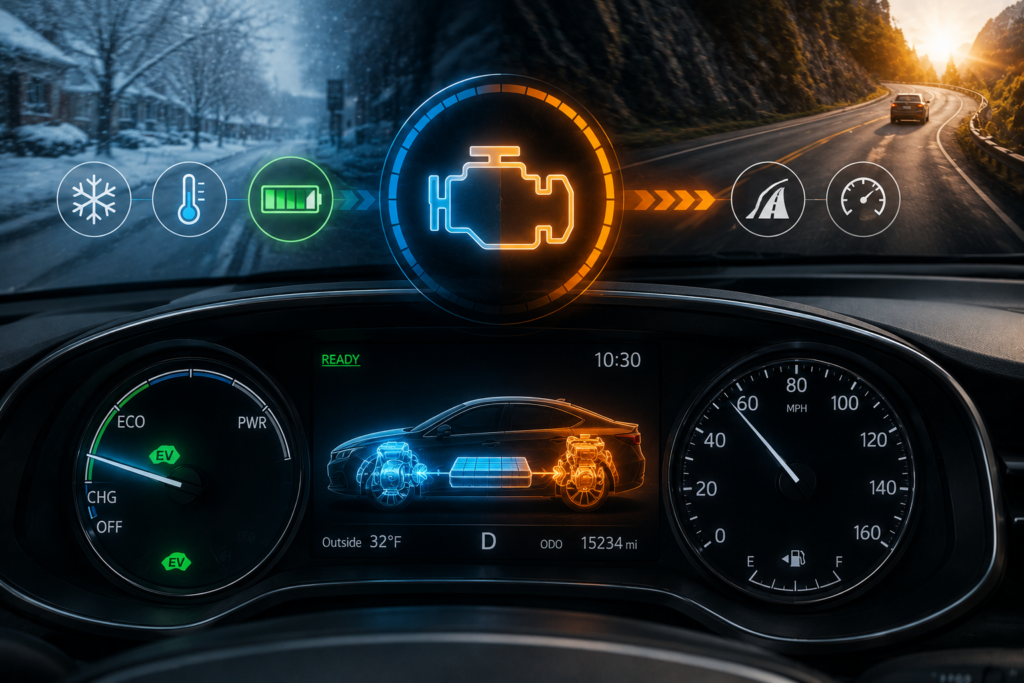
The engine may start even when the battery still has power left. That is completely normal in today’s hybrids.
Common Reasons the Engine Starts
- Rapid acceleration needs extra torque.
- Cabin heating in winter may require engine heat.
- The battery may be too cold or too hot.
- Highway speeds reduce EV efficiency.
- The system may recharge the battery proactively.
Drivers often notice this during winter mornings when the engine starts sooner than expected.
Some recent Toyota and Honda hybrids now start the engine earlier during steep climbs to reduce battery stress and improve long-term reliability.
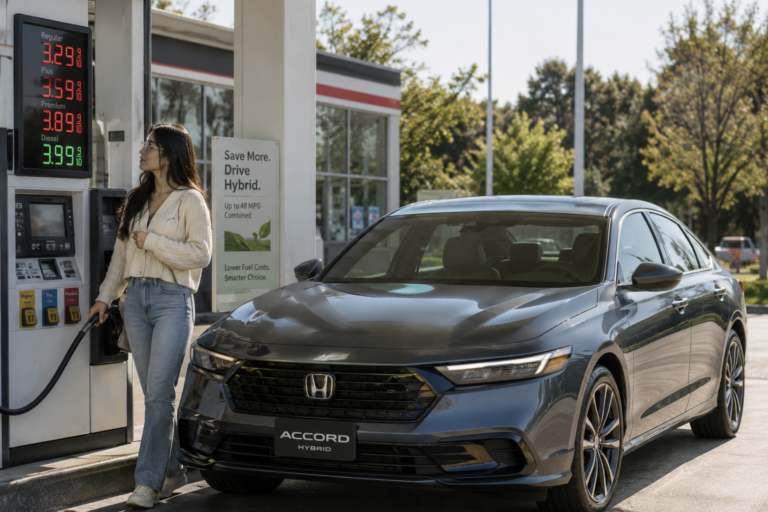
Also Read: How does Honda Accord Hybrid work?
How Does a Hybrid Switch Work While Driving?
Most switching happens quietly enough that drivers barely notice it. The inverter and power control unit balance engine and motor torque very quickly.
For example, in stop-and-go traffic, the car may:
- Start in EV mode
- Turn on the engine during acceleration
- Shut the engine off while coasting
- Recharge the battery during braking
During busy city traffic, the engine may turn on and off repeatedly without most drivers noticing.
Some drivers first notice hybrid switching while waiting at traffic lights because the engine suddenly becomes silent.
Why Do Hybrids Switch Differently in City and Highway Driving?
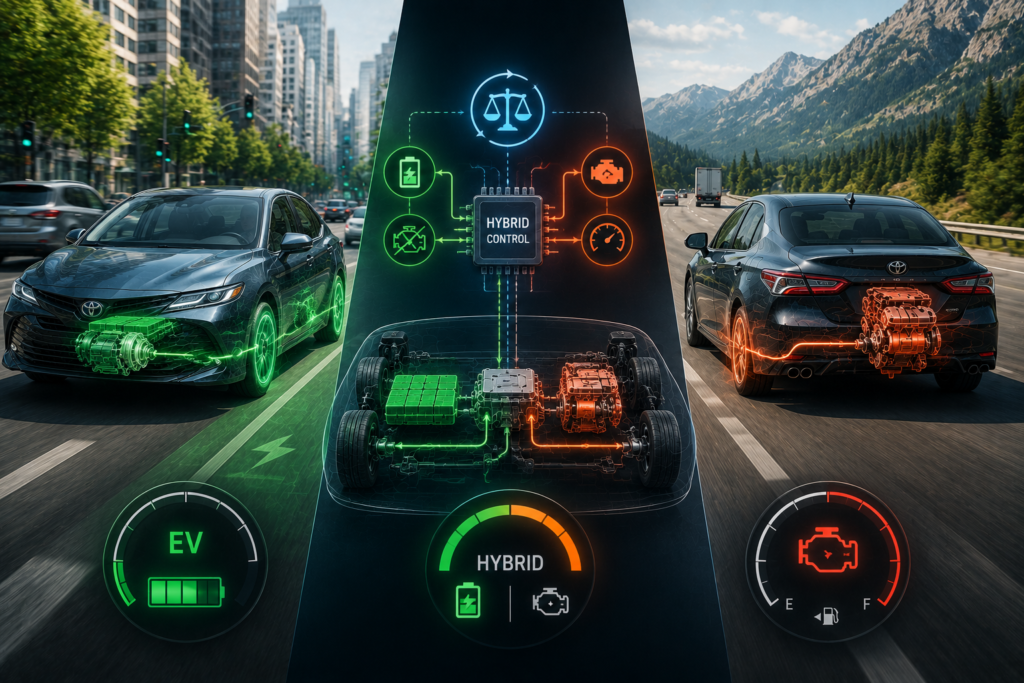
City and highway driving create completely different working conditions for a hybrid system. In slow city traffic, electric motors are more efficient because they handle low speeds and frequent stops without using much energy. But on highways, where speeds stay steady for longer periods, the gasoline engine becomes the more efficient option for continuous power delivery.
That is why hybrids behave differently depending on where you drive. In cities, the car often feels quiet and mostly electric, while on highways, the engine stays active for longer stretches, giving a more consistent but less electric driving feel. This difference is also why many hybrids achieve better fuel economy in city driving compared to highway driving, where sustained engine use becomes more common.
What Happens During Hard Acceleration?
Hard acceleration changes hybrid behavior immediately. The system focuses more on power than fuel savings. During overtakes, the engine sound becomes more noticeable because both power sources work together.
What the Hybrid Does
- The engine starts quickly for extra torque.
- The electric motor adds instant acceleration.
- Battery power drains faster under heavy load.
- Some hybrids reduce EV-only driving temporarily afterward.
You can usually hear the engine become more active during quick overtakes or highway merging.
Recent hybrid SUVs react faster because electric motors now deliver stronger low-end torque than many older setups.
How Does Regenerative Braking Affect Switching?
Regenerative braking helps recharge the battery while slowing down. The system captures some of the energy normally lost during braking while the electric motor acts like a generator.
This recovered energy helps the car stay in EV mode longer during city driving. In recent hybrid models, regenerative braking can recover more energy in stop-and-go traffic than older versions.
In real driving, you feel regenerative braking mostly in traffic. When you lift your foot off the accelerator, the car slows down slightly while quietly charging the battery. It feels different from normal braking because the energy is being recovered instead of wasted.
Why Does the Engine Start Even With Battery Power Left?
Many drivers think the battery should fully power the car until empty. Hybrids do not work that way.
The system protects battery life by keeping a reserve charge available. Many current hybrid cars avoid using the full battery range because deep discharge shortens battery lifespan. This is often noticeable when you’re waiting at a signal and suddenly hear the engine start.
Why Reserve Power Matters
- Prevents battery overheating
- Reduces long-term battery wear
- Keeps emergency power available
- Improves battery lifespan
That is why the engine may start even at 40 to 60% battery charge.
How Does the Hybrid Computer Control Switching?
The hybrid computer receives information from many sensors every second. It constantly adjusts power delivery based on efficiency and performance needs.
Sensors the System Uses
- battery temperature sensors
- wheel speed sensors
- throttle position sensors
- engine load sensors
- road incline detection
In many hybrids, these adjustments happen hundreds of times during a normal drive.
Recent hybrid technology processes this data faster than older vehicles. Some of the latest hybrid models can make switching decisions in milliseconds.
Why Do Hybrids Use the Engine More in Cold Weather?
Cold weather directly affects how efficiently hybrid batteries can deliver power. Lithium-ion batteries become less responsive in low temperatures, which means the system cannot rely on electric power as much as it does in normal conditions.
Because of this, the engine is used more frequently not just for driving, but also for warming the cabin and helping maintain proper battery temperature. In some situations, it also prevents the battery from working under stress when conditions are too cold. On steep roads or hills, this effect becomes even more noticeable because the engine supports an extra load. This is one of the main reasons fuel economy drops during the winter months in hybrid vehicles.
Read Guide: How long do Honda Accord Hybrid batteries last
How Do Hybrids Protect the Battery During Switching?
Hybrid vehicles are designed to protect battery health over many years. The computer avoids extreme charging and discharging.
| Protection Method | Purpose |
| Reserve battery buffer | Prevents deep discharge |
| Thermal management | Controls battery heat |
| Controlled charging | Reduces battery stress |
| Engine assistance | Lowers battery workload |
This protection strategy is one reason many hybrid batteries last well beyond 150,000 miles.
Can Drivers Control When a Hybrid Switches Modes?
Many current hybrid cars manage switching automatically. Drivers cannot fully control it because the system prioritizes efficiency and battery protection.
Some models include:
- EV mode buttons
- Eco mode
- Sport mode
Even EV mode buttons only work when battery and temperature conditions allow it. But these modes still work within safety and battery limits. The car can override the driver if needed.
Does Switching Between Engine and Motor Happen Instantly?
Yes. In many current hybrid cars, switching happens extremely fast. Drivers often cannot feel the transition at all.
Older hybrids sometimes had noticeable engine startup vibration. Recent Toyota and Honda hybrids improved insulation, inverter response, and torque balancing, so the change feels less noticeable than older hybrid models.
Toyota and Honda hybrids are known for smoother switching compared to some older, early-generation systems.
Are Hybrid Engine Switches Normal?
Yes, frequent switching is completely normal behavior. Hybrids are designed to constantly change between power sources to improve efficiency.
Normal Hybrid Behaviors
- The engine is turning on briefly in traffic
- EV mode stops during acceleration
- battery level moving up and down
- The engine runs longer in winter
These behaviors usually do not mean something is wrong.
What Are the Biggest Myths About Hybrid Switching?
Many drivers misunderstand how hybrid vehicles actually work.
| Myth | Reality |
| The battery should fully drain first | Hybrids keep a reserve charge |
| Engine startup means a problem | Frequent switching is normal |
| EV mode works at all speeds | High speeds often need engine power |
| Drivers fully control switching | The computer controls most decisions |
| Hybrids only save fuel in cities | Many hybrid vehicles also improve highway efficiency |
The biggest change in recent hybrid technology is better power management. Today’s hybrids no longer react only to speed. They now predict driving conditions, protect battery health more carefully, and switch power sources with less noticeable changes than older hybrid vehicles.
FAQ’s
Does a hybrid switch between engine and motor automatically?
Yes. The system changes power sources automatically based on speed, battery charge, and driving conditions.
Can a hybrid run only on the electric motor in city traffic?
Yes, many hybrid vehicles can drive short distances in EV mode during slow traffic and light acceleration.
Why does my hybrid engine turn on even with battery power left?
The engine may start to protect the battery, provide cabin heat, or deliver extra power during acceleration.
How do hybrids decide when to use the gasoline engine on highways?
Hybrids often use the engine at highway speeds because it becomes more efficient during steady long-distance cruising.
Is it bad if a hybrid frequently switches power sources?
No. Frequent switching is part of normal hybrid operation, especially in city driving.
Conclusion
Hybrid vehicles are designed to switch between the electric motor and gasoline engine based on real-time driving conditions. Recent Toyota, Honda, Hyundai, and Ford hybrids react faster and manage battery power more carefully than older models. They improve fuel economy, reduce emissions, and help drivers move through traffic with less fuel use. Understanding how hybrid switching works can also help drivers recognize that sudden engine starts and EV-mode changes are usually normal.