What Is Honda Hybrid Powertrain and How Does It Work? (Hybrid Secrets)
Honda’s hybrid powertrain combines electric motors, a gasoline engine, and a battery system to improve fuel economy and daily driving efficiency. In most low-speed driving situations, the car behaves almost like an EV while the gasoline engine helps generate electricity or assist at higher speeds.
Understanding how the Honda hybrid powertrain works helps drivers understand why the car behaves differently from a normal gasoline vehicle.
How Does the Honda Hybrid Powertrain Work?
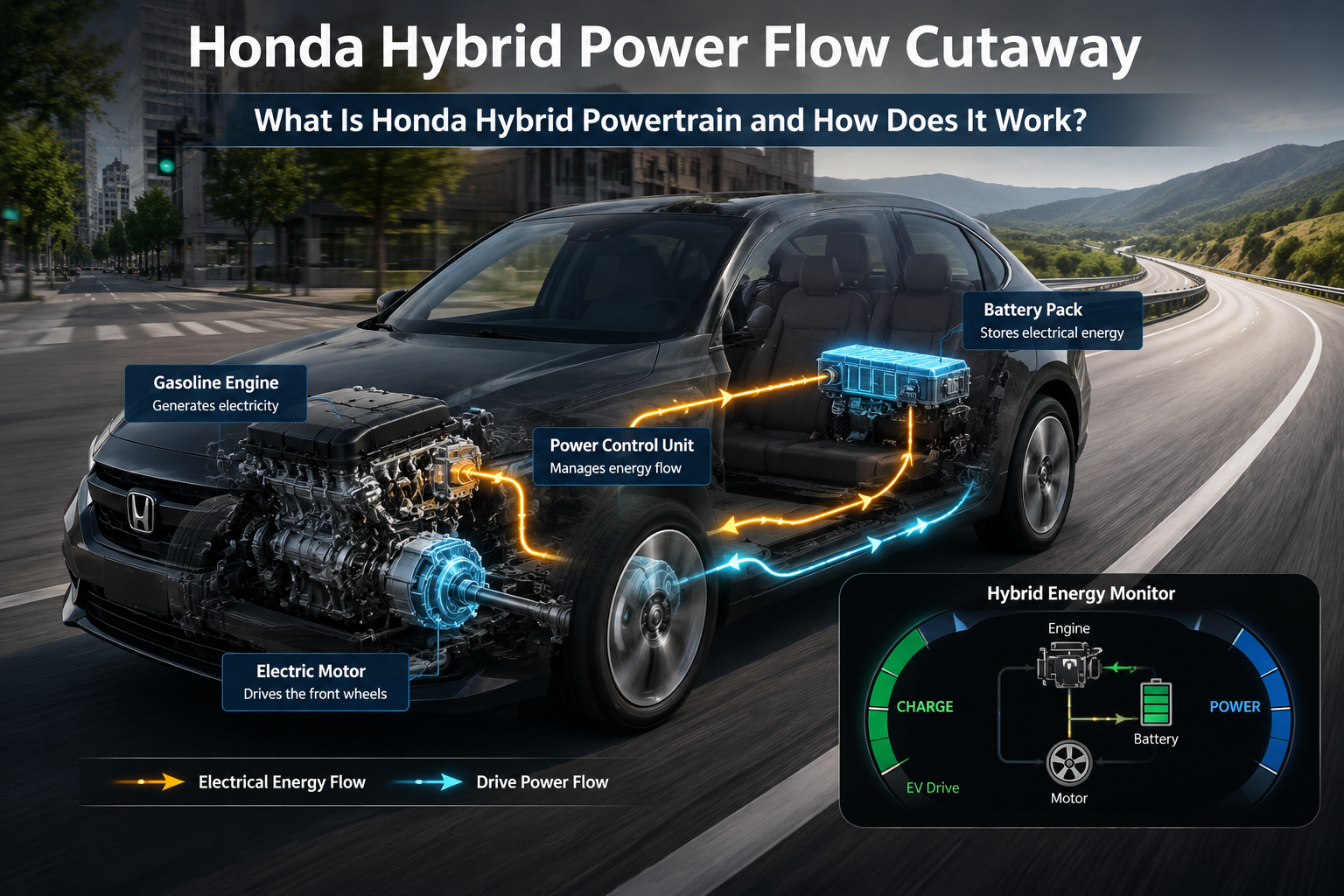
Honda’s hybrid powertrain works differently from what most drivers expect. In most situations, the wheels are powered mainly by an electric motor, while the gasoline engine often works like a generator, producing electricity for the battery and motor.
Honda’s newer two-motor hybrid system used in Accord, CR-V, and Civic Hybrid models feels more natural than older hybrids because power delivery happens very smoothly. Most drivers do not even notice when the engine starts or stops in city traffic.
Also Read: How Does Honda Accord Hybrid Work?
Main Parts Inside Honda Hybrid Powertrain
| Component | Job Inside the System |
| Electric Drive Motor | Powers the wheels most of the time |
| Gas Engine | Generates electricity and helps at high speeds |
| Generator Motor | Converts engine power into electricity |
| Lithium-Ion Battery | Stores electric energy |
| Lock-Up Clutch | Connects the engine directly during highway driving |
In real driving, especially in traffic-heavy cities. This system behaves more like an EV in traffic than many people expect.
Does Honda Hybrid Use a Normal Transmission?
No. Honda hybrids do not use a traditional automatic transmission in the normal sense.
Most modern Honda hybrids use an electronic CVT-style system without regular gear changes. Instead of shifting gears repeatedly, the electric motor handles acceleration quietly and smoothly.
Read Guide: What Is Ecvt In Honda Accord Hybrid
Why It Feels Different
- No hard gear shifts during acceleration
- The electric motor responds instantly
- Less engine strain in stop-and-go traffic
- More consistent power delivery in traffic
A lot of drivers expect a rubber-band CVT feeling. Honda’s hybrid system usually feels more natural than that after a few days behind the wheel.
Why Does the Honda Hybrid Feel Different to Drive?
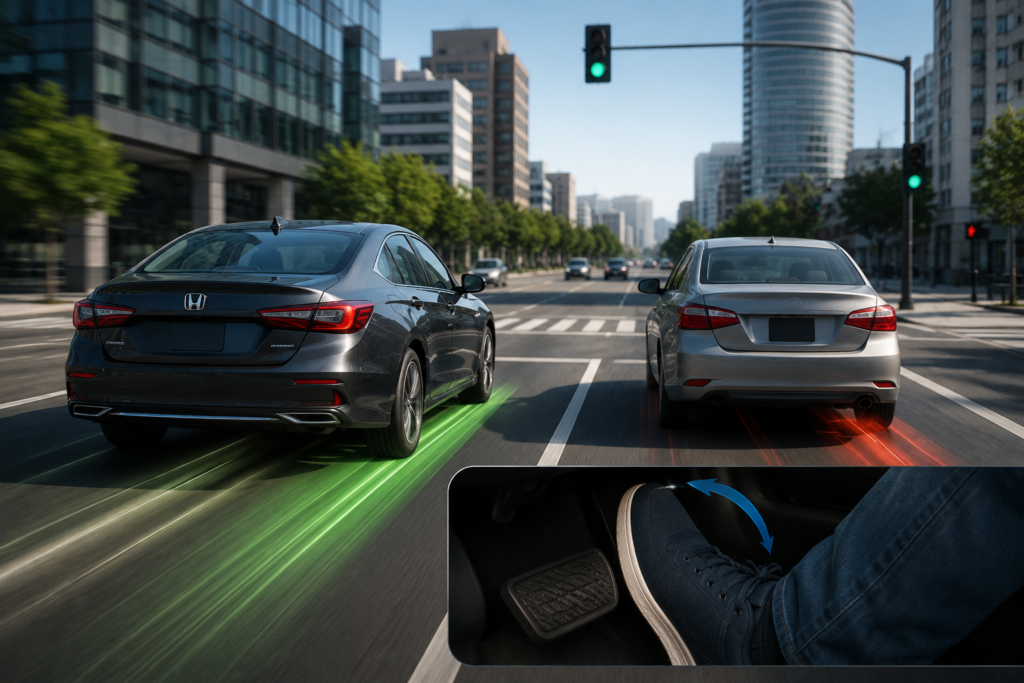
The driving feel changes mainly because electric motors produce instant torque. You press the pedal, and the car reacts immediately without waiting for downshifts.
What surprises most drivers is not speed, but how instantly the car responds in normal traffic without any delay. You notice it most when pulling away from traffic lights because the electric motor already has torque ready.
You Notice This Most During:
- Stop-and-go traffic
- Parking lot driving
- Slow city acceleration
- Highway merging from low speeds
At first, it feels a bit unusual, but after a few days, most drivers stop thinking about it completely.
How Does Honda’s Hybrid Switch Between Gas and Electric Power?
Instead of fixed gear behavior, the system constantly decides the most efficient way to use the engine and electric power in real time.
How Power Changes in Different Situations
| Driving Situation | Main Power Source |
| Slow City Driving | Electric motor |
| Moderate Acceleration | Hybrid combination |
| Highway Cruising | Gas engine + electric assist |
| Braking | Regenerative charging |
During calm city driving, the engine may shut off completely for short periods. At highway speeds, the gasoline engine becomes more active because it operates more efficiently there.
Why Does the Engine RPM Rise Suddenly?
If you are driving a hybrid for the first time, the RPM behavior can feel unusual at first, but it is completely normal in Honda’s system.
Sometimes the engine RPM rises even when the car is not accelerating aggressively. That usually happens because the engine is generating electricity or helping recharge the battery.
The transmission is normally not slipping.
What Usually Causes High RPM in Honda Hybrids?
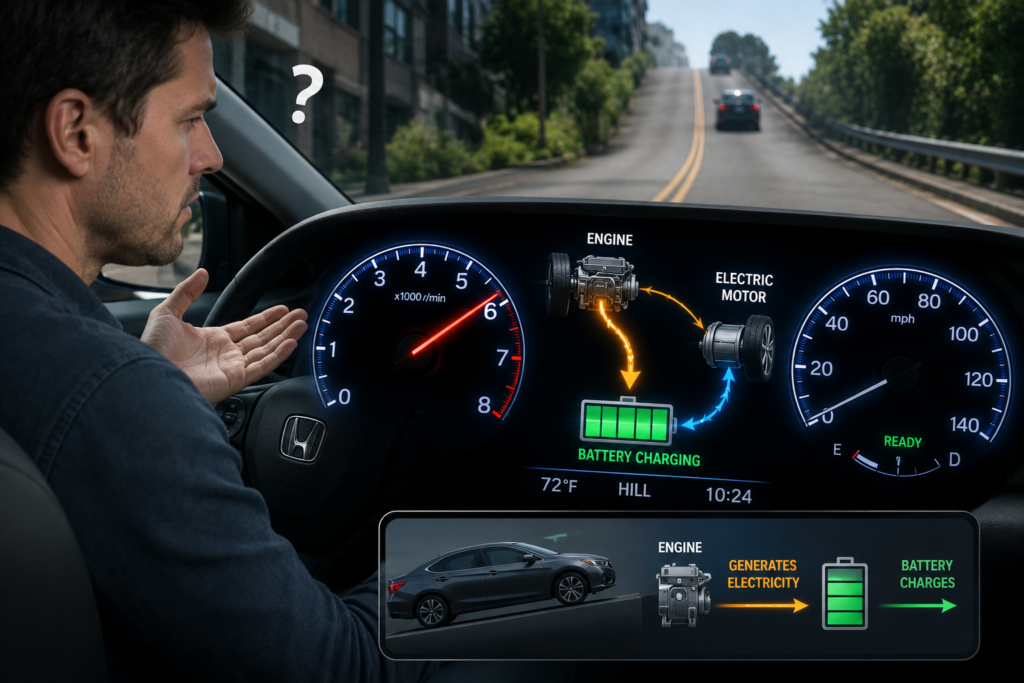
- Battery charging under load
- Uphill driving
- Heavy acceleration
- High AC usage in hot weather
- Highway climbing
A lot of first-time hybrid owners think something is wrong during the first week because engine RPM and road speed are not always directly connected like a normal gasoline car.
What Happens Inside a Honda Hybrid at Highway Speeds?
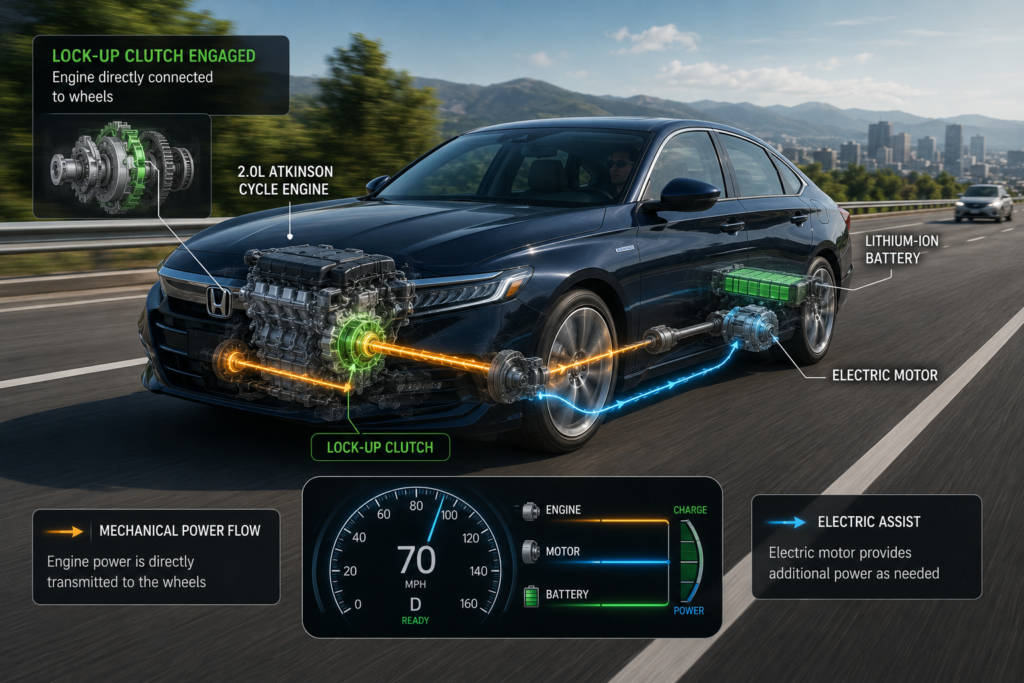
At highway speeds, Honda’s hybrid system changes behavior slightly. The gasoline engine can connect more directly to the wheels for better efficiency during long-distance cruising.
In real highway driving, especially in 2023 to 2026 models, Honda has tuned the system to feel more stable during overtakes and uphill driving.
Highway Behavior vs City Behavior
| Situation | What the System Does |
| City Traffic | Mostly electric drive |
| Highway Cruising | The engine assists directly |
| Passing Cars | Electric boost + engine power |
| Long Uphill Roads | The engine stays active longer |
You usually notice the biggest difference during highway overtakes. The newer Honda hybrids feel calmer and less noisy than many older hybrid systems.
How Does Regenerative Braking Work in Honda Hybrids?
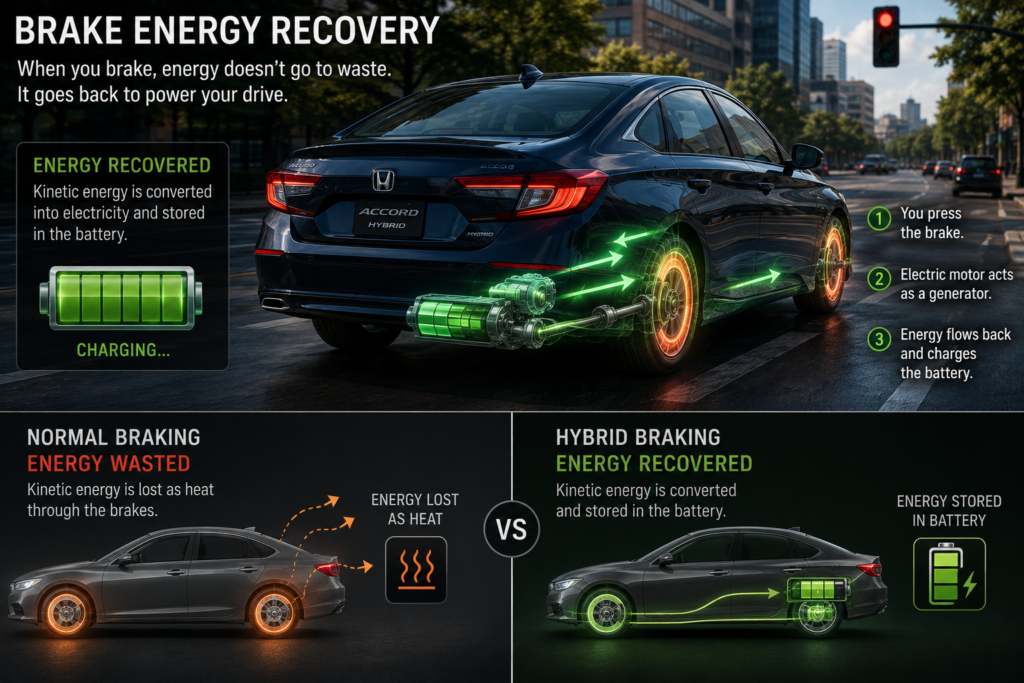
Regenerative braking helps recharge the battery while slowing down. Instead of wasting braking energy as heat, the electric motor converts some of that energy back into electricity.
That is one reason Honda hybrids get strong fuel economy in city driving.
What Drivers Usually Notice
- Slightly different brake feel at low speeds
- Battery charges while slowing down
- Less brake wear over time
- Better fuel efficiency in traffic
Some drivers notice the brake pedal feels slightly softer at first. Most adapt to it very quickly.
Is Honda’s Two-Motor Hybrid System Reliable?
Yes, Honda’s newer two-motor hybrid system has developed a strong reliability reputation across Accord, CR-V, and Civic Hybrid models.
Unlike many traditional CVTs, Honda’s system avoids belt-and-pulley designs, which removes some common long-term wear points.
Why Many Owners Trust Honda Hybrids
- Fewer moving transmission parts
- No traditional CVT belt wear
- Lower stress during acceleration
- Proven in multiple Honda models
- Strong reliability history since earlier Accord Hybrid generations
From a long-term ownership perspective, Honda’s hybrid system has proven more stable than many early CVT-based setups.
That does not mean problems never happen, but serious hybrid transmission failures are still relatively uncommon.
Does a Honda Hybrid Need Maintenance?
Yes, but maintenance is usually simpler than many people expect.
Honda hybrids still need fluid service, cooling system checks, tire maintenance, and battery monitoring. Skipping maintenance completely is still a mistake.
Common Honda Hybrid Maintenance Items
| Maintenance Item | Typical Need |
| Hybrid System Fluid | Periodic service |
| Engine Oil Changes | Regular |
| Cooling System Check | Important |
| Brake Inspection | Needed occasionally |
| Hybrid Battery Check | Sometimes recommended |
The good news is brake wear is often lower because regenerative braking handles part of the stopping work.
Is the Honda Hybrid Better Than the Toyota Hybrid?
Both systems are excellent, but they feel different on the road.
Toyota hybrids usually focus more on maximum efficiency and smoother cruising. Honda hybrids often feel quicker and more responsive during acceleration.
Honda Hybrid vs Toyota Hybrid:
| Feature | Honda Hybrid | Toyota Hybrid |
| Low-Speed Response | Faster feeling | Smoother |
| Highway Feel | More natural | Relaxed |
| Driving Personality | Slightly sporty | Comfort-focused |
| Fuel Economy Focus | Strong | Excellent |
In real driving, both are very good. The bigger difference is usually driving character rather than reliability.
What Are the Biggest Honda Hybrid Myths?
Many hybrid myths still come from older technology or confusion with traditional CVTs.
Common Honda Hybrid Myths
Honda hybrids use weak CVT belts.
Honda’s newer hybrid system does not use a normal CVT belt-and-pulley setup.
The transmission is slipping. High RPM behavior is usually part of normal hybrid operation.
Hybrid batteries fail quickly.
Modern Honda hybrid batteries generally last much longer than early hybrid systems from years ago.
Hybrids feel slow.
The instant electric torque actually makes Honda hybrids feel surprisingly responsive in traffic.
A lot of criticism online comes from people who have never driven a newer Honda hybrid for more than a few minutes.
Is a Honda Hybrid Worth Buying in 2026?
For most drivers, yes.
Compared to older hybrids from years ago, newer Honda models feel much quieter and more natural in daily driving. The newer Accord and CR-V hybrids especially feel quieter and more natural during daily driving.
Who Usually Likes Honda Hybrids Most?
- Daily commuters
- Highway drivers
- Drivers want better fuel economy
- Long-term owners
- People are tired of rough stop-and-go driving
The biggest surprise for many buyers is how normal the car feels after a few days. After a week or two, most drivers barely pay attention to the system anymore once they get used to it.
FAQ’s:
Does Honda Hybrid Charge While Driving?
Yes, Honda hybrids recharge the battery while driving through the gasoline engine and the regenerative braking system.
Why Does Honda’s Hybrid Sound Like It Is Revving Too High?
The engine may be raised to RPM to generate electricity or recharge the battery. That sound is usually normal during hybrid operation.
Can a Honda Hybrid Run Without the Gas Engine?
Yes, for short periods. During slow driving or light acceleration, the electric motor can power the car without the gas engine running.
Do Honda Hybrids Work Well on Highways?
Yes, Newer Honda hybrids perform much better on highways than many older hybrid systems and stay efficient during long trips.
How Long Does a Honda Hybrid Battery Usually Last?
Most Honda hybrid batteries can last well over 100,000 miles with proper maintenance and normal driving conditions.
Conclusion:
Honda’s hybrid powertrain is designed to deliver quieter driving, better fuel economy, and more efficient performance than many traditional gasoline cars. The newer two-motor system feels far more advanced than older hybrid setups, especially during traffic and highway driving. After spending some time behind the wheel, most drivers adapt to the hybrid behavior very quickly.