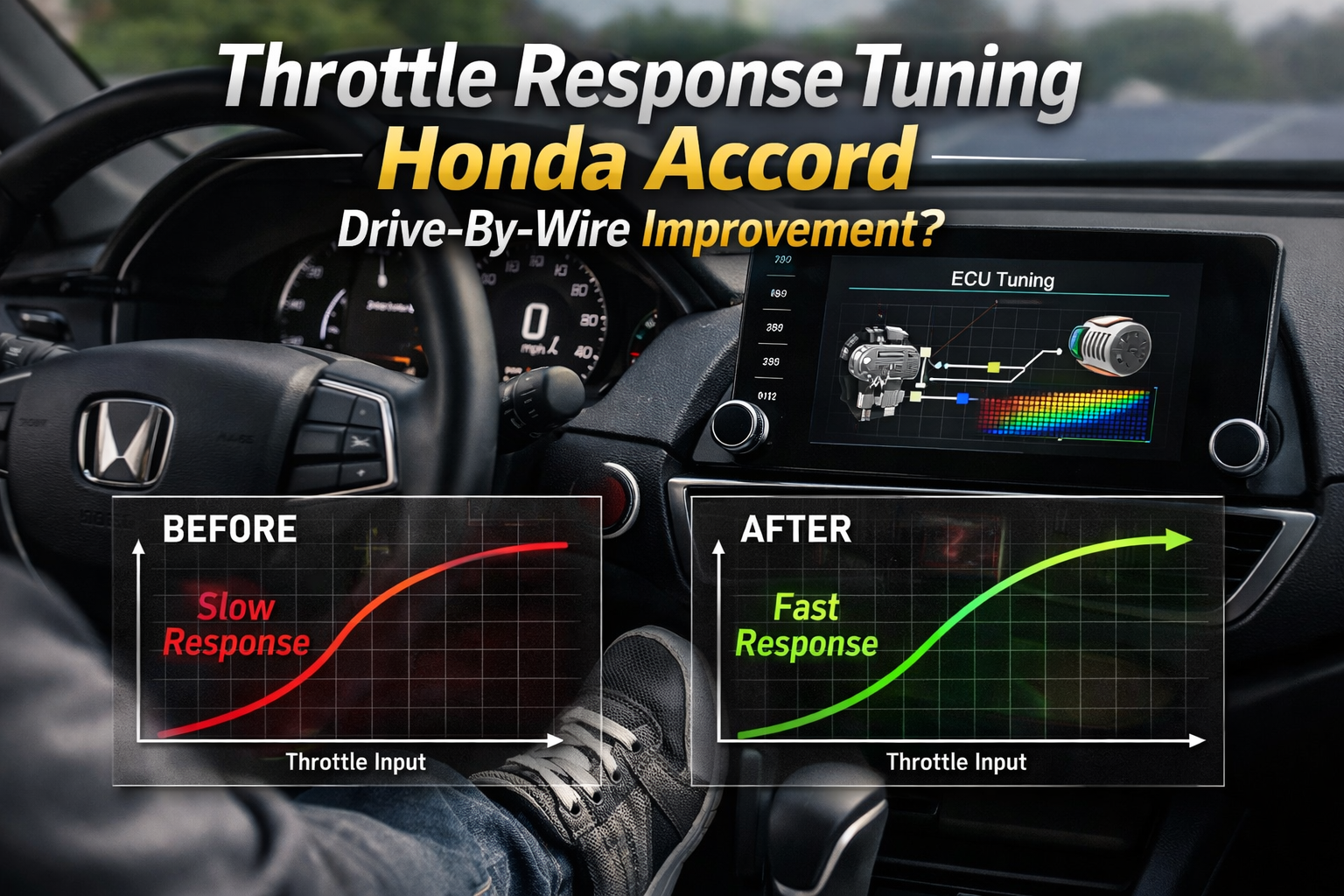
Throttle Response Tuning Honda Accord Drive By Wire Improvement? Learn More!
Throttle response tuning for a Honda Accord with drive-by-wire improves pedal sensitivity by adjusting electronic throttle mapping through ECU tuning or throttle controllers. It reduces lag, delivers quicker acceleration, and makes the car feel more responsive without major hardware modifications.
Also Read: How To Increase Honda Accord Horsepower Without Turbo?
In this guide, we will learn about Throttle Response Tuning Honda Accord Drive By Wire improvement and how it can significantly improve your driving experience.
What Is Honda’s Drive-By-Wire System?
Honda uses an electronic throttle instead of a physical cable. The gas pedal sends a signal to the ECU, and the ECU decides how much the throttle body opens.
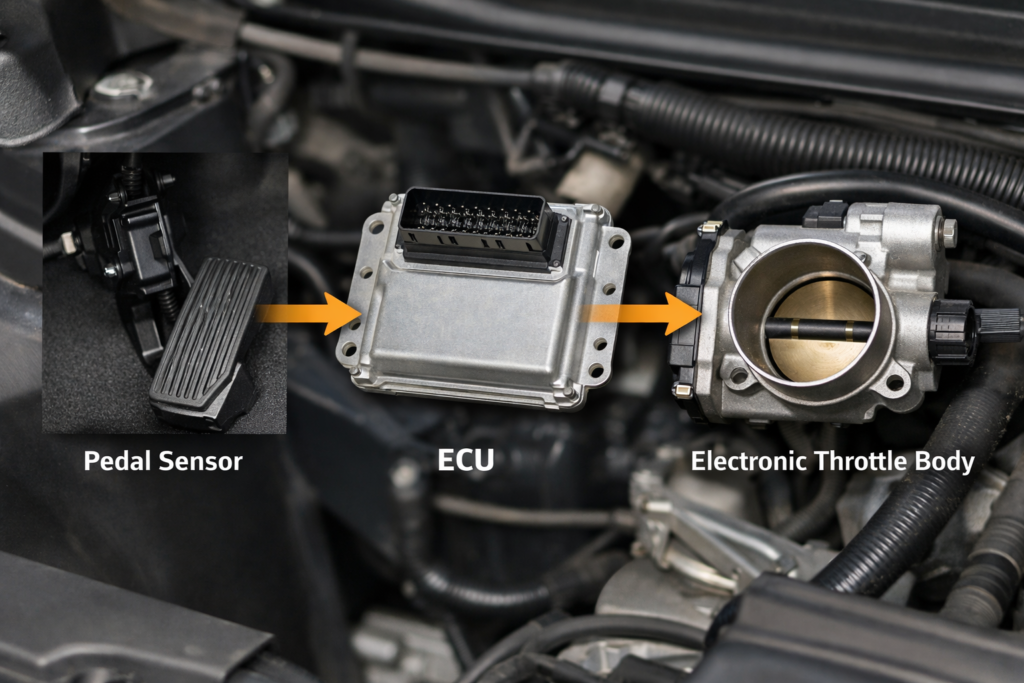
The system is tuned for smooth driving and fuel efficiency, not instant reaction. That is why many drivers feel a slight hesitation when pressing the pedal quickly.
Key Points:
- No physical cable connects the pedal to the throttle.
- ECU controls throttle opening electronically.
- Designed for smoothness, efficiency, and safety.
- A small response delay is normal.
For more details on Honda’s system, check out this official explanation from Honda.
Why Does the Honda Accord Have Throttle Lag?
Throttle lag happens because the ECU filters your pedal input. It prevents jerky acceleration, protects the transmission, and improves fuel economy. You will notice it most when pulling away from a stop, overtaking, or tapping the pedal in traffic. The car responds, just not immediately.
Main Causes:
- ECU softens sudden pedal input.
- The electronic throttle reacts more slowly than the cable.
- CVT and automatic tuning prioritize smoothness.
- Emissions and fuel economy programming.
Also Read: Why Does My Honda Accord Jerk When I Accelerate?
Does a Throttle Controller Actually Fix Lag?
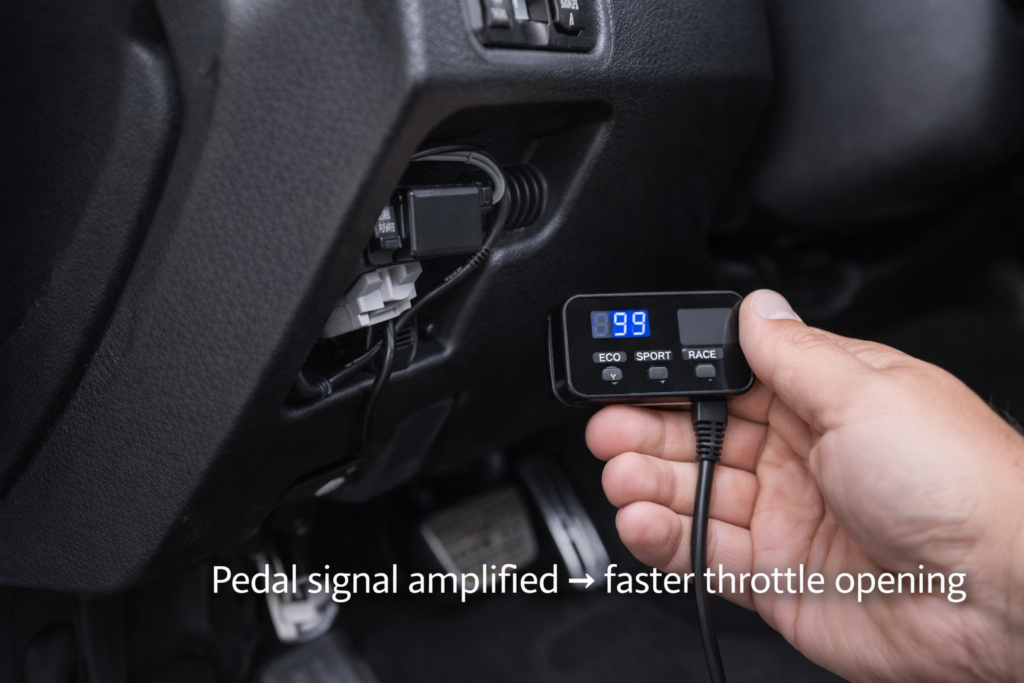
A throttle controller changes how fast the throttle opens when you press the pedal. It does not add power, but it removes the feeling of laziness. The engine does not gain power, but the throttle reacts sooner, so the car feels more eager when you press the pedal. This happens because the throttle mapping curve becomes more responsive, allowing quicker throttle opening for the same pedal input. The controller essentially changes pedal signal scaling, so small pedal movement produces a faster throttle reaction.
What It Really Does:
A throttle response controller reduces the delay between pressing the accelerator pedal and the throttle opening, making the car react more quickly to your input. It creates the sensation of faster acceleration almost instantly, even though it does not increase actual horsepower. Since it is a plug-and-play modification, it can be installed easily and removed at any time without permanently altering the vehicle.
Is ECU Throttle Tuning Better Than a Pedal Controller?
Both improve response, but they work differently. ECU tuning changes the engine’s real behavior, while a pedal controller only changes pedal sensitivity.
ECU tuning is deeper and smoother, but it costs more and needs proper calibration.
| Feature | ECU Throttle Tune | Pedal Controller |
| Response Quality | Smooth and natural | Sharp but artificial |
| Power Change | Slight improvement possible | No power gain |
| Cost | Higher | Lower |
| Installation | Requires tuning | Plug & play |
| Safety | Safe if tuned properly | Generally safe |
From real-world testing, ECU tuning delivers smoother and more natural throttle behavior, while pedal controllers feel sharper but sometimes slightly artificial in low-speed driving.
Does Throttle Response Tuning Increase Horsepower?
Throttle Response Tuning Honda Accord Drive By Wire Improvement? It mainly improves how fast power is delivered, not how much power the engine actually makes. Modern Honda ECUs use torque management and engine load smoothing, so throttle tuning changes response behavior rather than raw engine output. The quicker throttle makes acceleration feel more immediate and sharper, even though actual horsepower gains are minimal. The real power increase is very small unless throttle adjustments are combined with full ECU performance tuning and supporting modifications.
Reality Check:
- Mostly improves response, not power.
- Faster throttle = quicker feel.
- Real HP gains need full engine tuning.
- Best combined with intake + tune.
Also Read: How To Make Honda Accord V6 Faster Naturally Aspirated?
Is Throttle Tuning Safe for CVT and 10-Speed Transmissions?
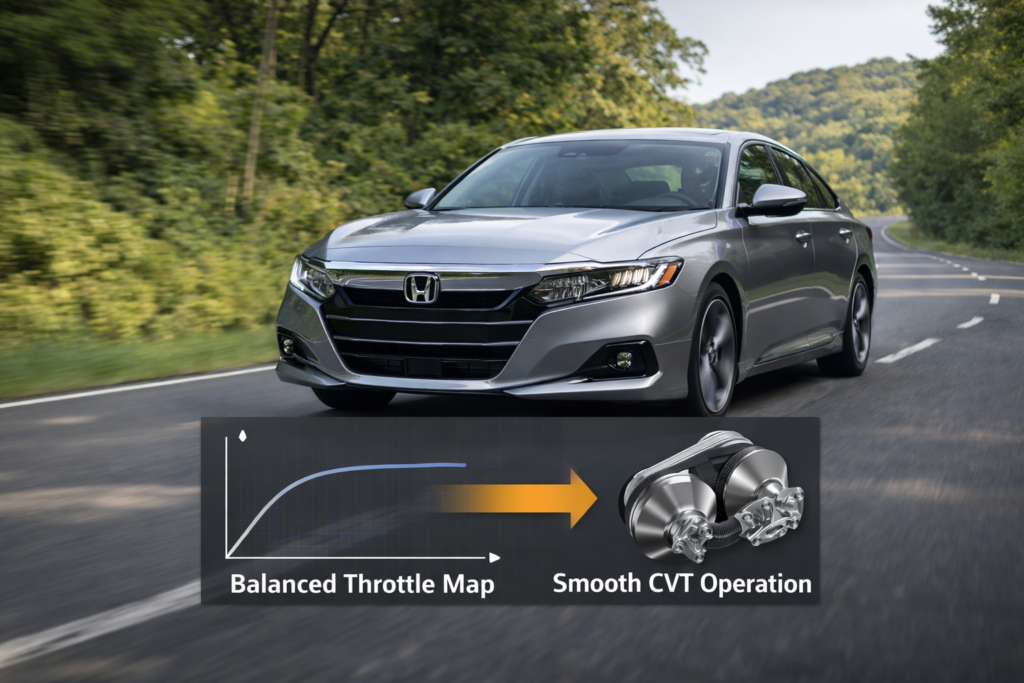
When done correctly, throttle tuning is safe. Problems only happen with aggressive, poorly calibrated tunes. Mild response tuning keeps transmission protection active and does not harm CVT or automatic gearboxes.
With conservative tuning, the system remains safe because factory CVT and automatic protection strategies stay active. Issues usually arise only when extremely aggressive maps are used that create sudden torque spikes. Using high-quality, reputable tuning tools further reduces risk and ensures smoother calibration.
In very aggressive modes, low-speed driving can feel slightly jerky, especially in heavy traffic. That is why a balanced setup usually delivers the best real-world result. A mild or balanced setup keeps the car smooth and protects long-term reliability.
Wondering which gear really keeps your Honda Accord smooth and safe? Check out What Gear to Drive in a Honda Accord for tips that protect your CVT and 10-speed transmission while tuning throttle response!
How Much Faster Will a Tuned Accord Feel?
Throttle tuning improves perceived speed, not raw acceleration numbers. The car reacts faster, launches smoother, and feels more alive in daily driving. In real driving feedback, most Accord owners report noticeable improvement in throttle response, especially in stop-and-go traffic and quick acceleration situations. See this Car and Driver review for more on the driving feel.
Right after tuning, most drivers notice quicker response in traffic, smoother pulls during overtakes, and better control in slow city crawl. Even during cold starts or uphill driving, the throttle feels more direct and predictable.
What You Will Notice:
- Faster pedal reaction.
- Quicker initial acceleration feel.
- Smoother overtakes.
- More responsive daily driving.
Also Read: When to Change Spark Plugs in Your Honda Accord?
What Is the Best Throttle Setup for Daily Driving?
The best setup balances smoothness and quick response. Too aggressive makes the car jerky and hard to control in traffic.
For everyday driving, a moderate throttle setup feels the most natural, quick enough to remove lag, but smooth enough for traffic and long drives.
Ideal Daily Setup:
- Mild or medium throttle sensitivity.
- Smooth, progressive response.
- No aggressive launch mapping.
- Balanced comfort and control.
Should You Tune Your Honda Accord or Leave It Stock?
If throttle lag annoys you, mild tuning is worth it. If you prefer factory smoothness and maximum reliability, stock is fine. If you are already improving intake airflow or ECU calibration, mild throttle tuning works even better as part of a balanced performance setup.
Smart tuning improves driving feel without hurting the engine, but unrealistic expectations lead to disappointment.
Final Decision Guide:
- Tune in if lag bothers you on a daily basis.
- Stay stock if you want factory behavior.
- Use conservative, quality tuning only.
- Expect a better response, not big power.
If your goal is a sharper response and better driving feel, mild throttle tuning is one of the simplest and safest improvements you can make without modifying engine hardware.
FAQ’s:
Does throttle response tuning really improve driving feel?
Yes. It sharpens pedal reaction, reduces hesitation, and makes the car respond quicker in real driving without changing engine hardware.
Can a throttle controller damage the engine or transmission?
No. A properly used, moderate setting is safe because factory ECU protections for the engine and transmission remain active.
What is the difference between throttle tuning and full ECU tuning?
Throttle tuning adjusts pedal-to-throttle response, while full ECU tuning modifies fuel, timing, and torque mapping for deeper performance changes.
Why does drive-by-wire feel slower than a cable throttle?
Electronic throttles filter sudden pedal input for smoothness, fuel economy, and transmission protection, which creates a small but noticeable delay.
Should you choose aggressive throttle settings for daily driving?
Yes, but only mildly. A moderate setting removes lag while keeping acceleration smooth, controlled, and comfortable for traffic and daily use.
Conclusion:
Throttle response tuning removes hesitation and makes the Accord feel sharper without changing engine hardware. A balanced setup improves daily driving, keeps CVT and automatic transmissions safe, and delivers smoother control. Expect a better response, not big power. Choose conservative tuning, focus on real driving feel, and prioritize reliability for durability.