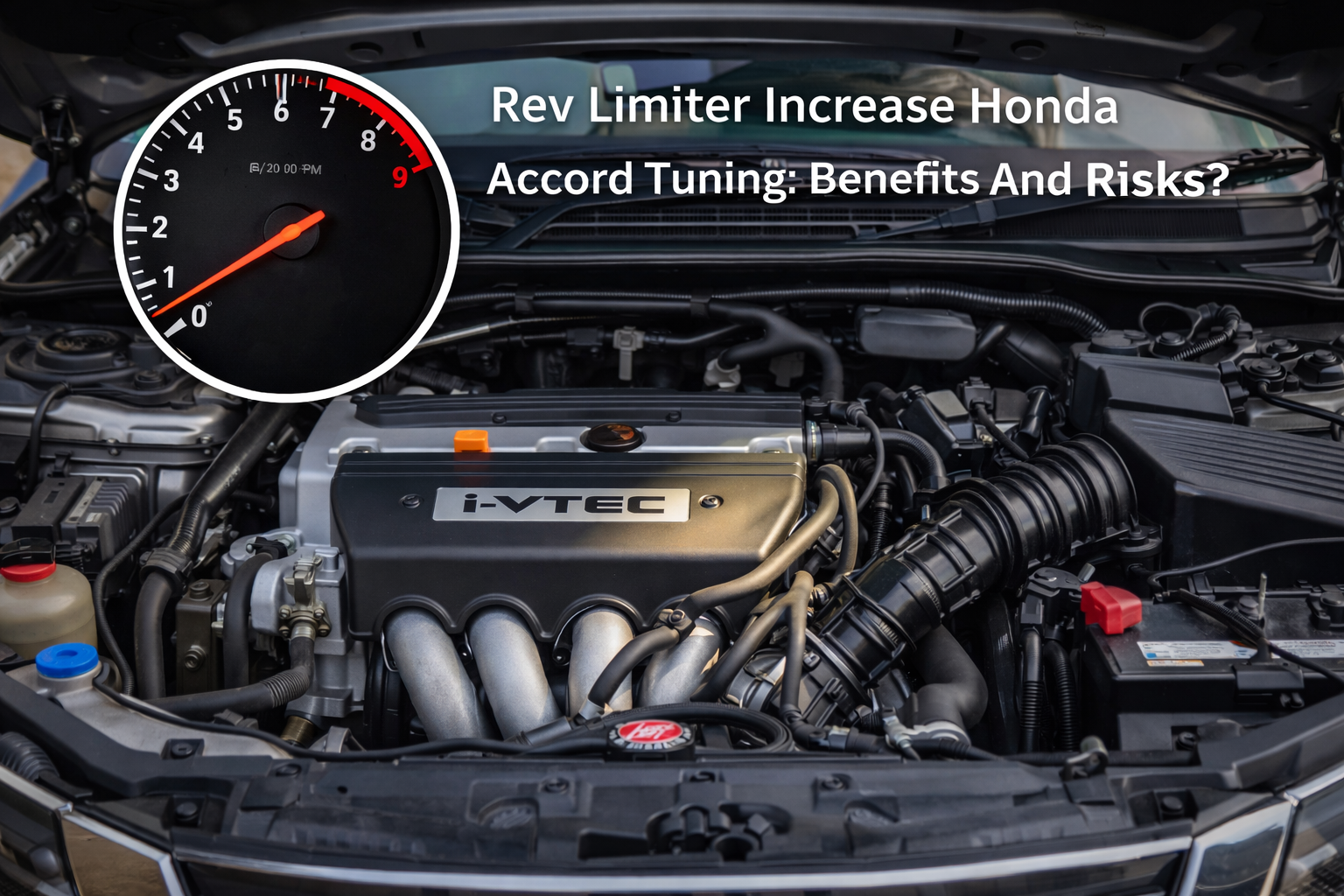
Rev Limiter Increase Honda Accord Tuning Benefits And Risks? Tune Smart!
Most Honda Accord owners think raising the rev limiter means more power. It does not. Not automatically. A higher redline only lets the engine spin longer. Whether that helps or slowly damages your engine depends on what is happening inside the motor.
This guide explains the real benefits, potential risks, and when raising the rev limiter is worth it.
What Does the Rev Limiter Actually Protect in a Honda Accord?
Rev Limiter Increase Honda Accord Tuning Benefits And Risks? The rev limiter is a safety feature, not a performance tool. Its main job is to protect critical engine components from mechanical overstress. It prevents pistons, rods, and valves from exceeding speeds where damage becomes likely.
At high RPMs, the forces on the connecting rods and valvetrain increase exponentially. Even small over-revs can lead to valve float, bent rods, or broken springs.
It protects the pistons and rod bearings first. Then the valvetrain. Even the timing system and oil pressure stability depend on staying below that limit.
Also Read: Throttle Response Tuning Honda Accord Drive By Wire Improvement?
How Honda Sets Factory RPM Limits (K24 vs J30 vs J35)?
Honda engineers set redlines using extensive stress testing and simulation. The goal is long-term durability, balancing rod and piston speed, valve spring stability, and oil delivery limits. Engine geometry, stroke length, and rod ratio all influence safe RPM.
| Engine | Factory Redline | Stroke | Valvetrain Type | RPM Stability |
| K24 | 6,800 RPM | 99mm | DOHC i-VTEC | Good control |
| J30 | 6,800 RPM | 86mm | SOHC VTEC | Moderate |
| J35 | 6,500 RPM | 89mm | SOHC VTEC | More stress |
The K24 has a longer stroke but a very stable DOHC valvetrain, making high RPMs more manageable. The J35, with a slightly lower redline, experiences more rod stress, especially near the limiter.
What Really Happens Inside the Engine at Redline?
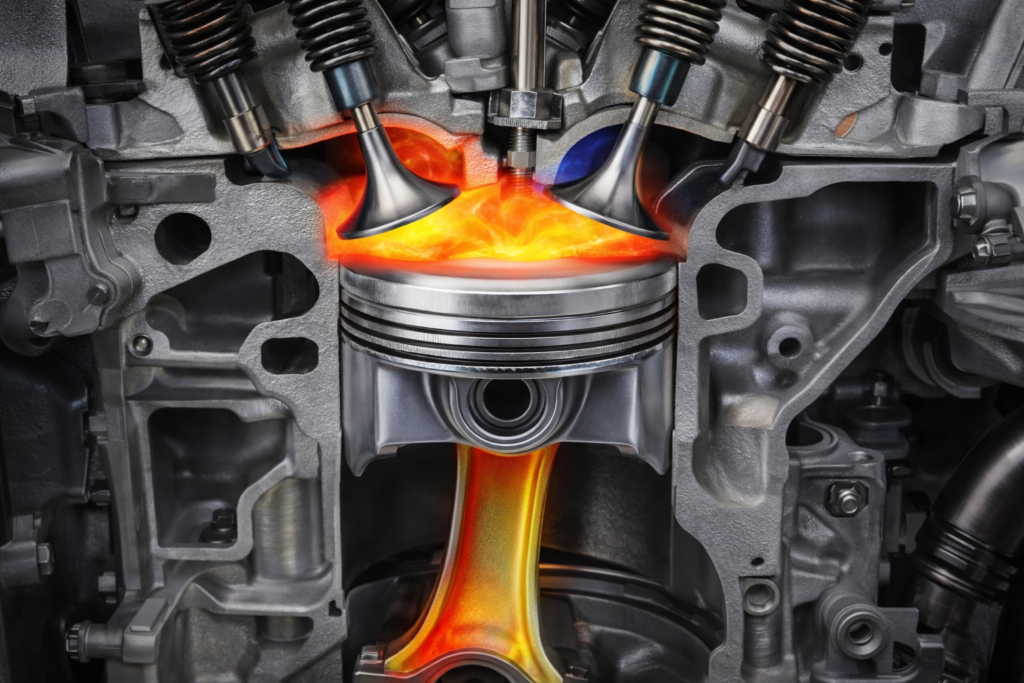
When an engine reaches redline, several mechanical risks emerge simultaneously:
- At redline, everything inside the engine is moving at high speed.
- Nothing explodes immediately. But clearances shrink. Stress builds. Wear accelerates. That is what redline really does.
- The valve springs are the first to lose control. Rods are under more tension than most people realise. As the temperature rises, oil viscosity drops faster than you expected.
Redline is not a goal. It is the line Honda drew for a reason. Even a single over-rev can accelerate wear on cylinder walls and valvetrain components.
You may also like to read: When to Get an Oil Change for Honda Accord?
Real-World Case: What Happens When You Push Too Far
A 2012 Accord owner increased his redline by 400 RPM on a stock K24. No valve spring upgrade. No oil system changes.
For two months, everything felt fine. Then high-RPM pulls started to feel rough.
The compression test later showed that cylinder 3 experienced a pressure drop. The valve float had started damaging the valvetrain.
The engine did not explode. It just slowly wore itself down.
This is how most over-rev damage happens, not instantly, but gradually.
Soft Cut vs Hard Cut Rev Limiters: What is the Difference?
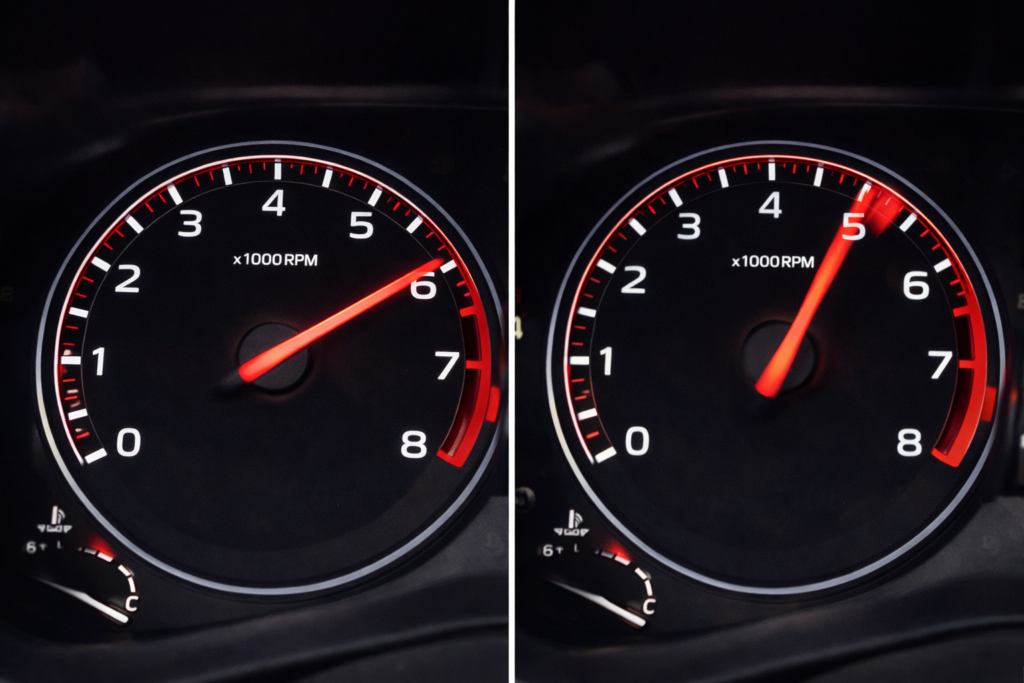
Soft cut and hard cut limiters act differently:
- Soft Cut: Gradually reduces fuel or ignition near redline. Smooth, avoids bouncing, safer for daily use.
- Hard Cut: Immediately cuts fuel/ignition, creating an abrupt stop at redline. It can cause stress to rods, transmission, and tyres.
Why it matters: A hard, bouncing limiter can repeatedly shock the bearings and valvetrain, shortening engine life. Soft cut preserves mechanical integrity while still preventing over-revs.
I have seen engines survive limiter abuse for years. And I have seen others start ticking after one bad habit. It is not always predictable.
Can You Safely Increase the Rev Limit on a Stock Engine?
Increasing the rev limit on a stock Honda engine is risky without supporting upgrades. Airflow, oil flow, and valvetrain strength define how far you can push safely.
A small bump of 100-200 RPM is usually tolerated by a healthy engine. Go 300 or more without upgrading valve springs, and you are gambling. The real limit is not the number on the screen. It is how well the engine breathes and how stable the valvetrain remains.
Think of it as stretching tolerance, not making more power.
What Supporting Mods Are Required Before Raising RPM?
Before raising redline, certain mechanical upgrades are critical:
- Stronger Valve Springs: Prevent valve float at high RPM.
- Oil Pump Upgrade: Maintain pressure at extreme speeds.
- Balanced Rotating Assembly: Reduces vibration from high-speed rotation.
- ECU Recalibration: Avoid lean mixtures or misfires at high RPM.
Without these, even a small increase in revs can cause long-term engine damage.
Which Honda Accord Engine Handles High RPM Better?
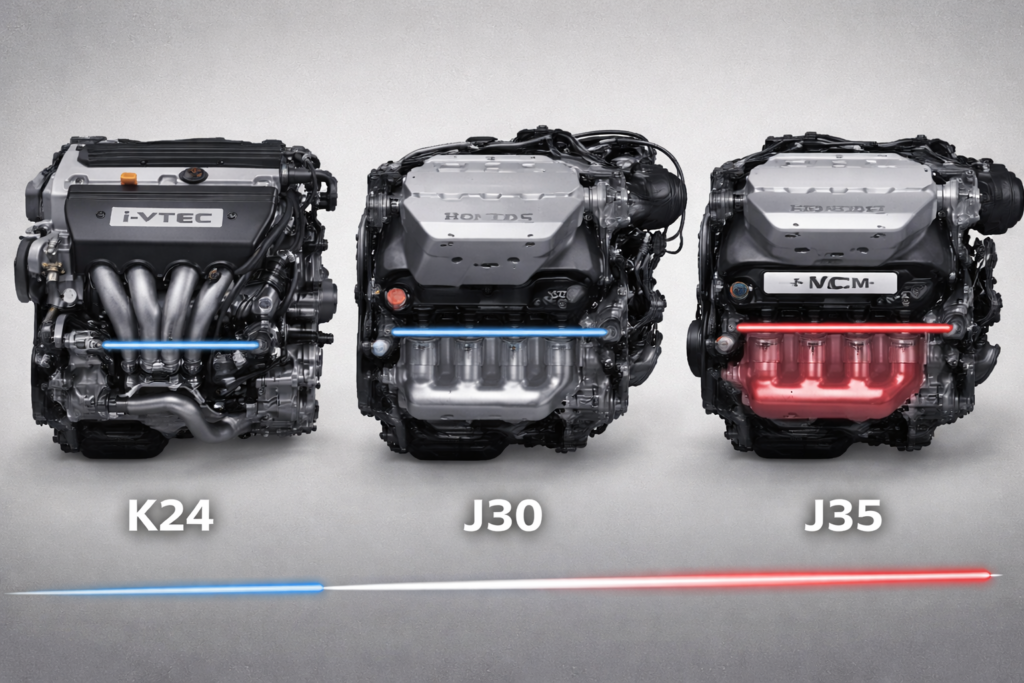
Different engines have different redline tolerances due to geometry and design.
The K24 handles higher RPMs better, primarily due to its valvetrain stability. The J30 sits in the middle. The J35, especially in heavier Accords, tends to show more stress near redline.
K24 is best suited to high-RPM naturally aspirated applications due to its valvetrain stability and piston-speed tolerance. J35 tolerates less abuse; the J30 sits in the middle.
What Damage Can Repeated Rev Limiter Hits Cause?
Frequent limiter hits increase wear in multiple systems:
- Ring Land Wear: Repeated extreme cylinder pressure damages piston rings.
- Bearing Stress: Rod and main bearings degrade faster.
- Transmission Shock: Sudden torque spikes can damage CVT or automatic transmission components.
- CVT Risk: Continuous high RPMs strain the belt and pulleys, reducing belt and pulley lifespan.
Even if a single limiter hit is survivable, repeated abuse shortens engine and drivetrain life noticeably. A single limiter hit would not damage your engine. Repeating it will.
Does Increasing RPM Extend the Powerband or Just Add Risk?
Raising redline shifts where power is usable, but it does not create new power. If your real goal is more acceleration, there are smarter ways to gain horsepower without touching the limiter.
Read Guide: How To Increase Honda Accord Horsepower Without a Turbo?
- Extending RPM can let you stay in a higher power range for a short time.
- Here is the mistake most people make. They think higher RPM means more power. It does not. If the engine cannot breathe better, spinning it faster only adds heat and wear.
Is Raising the Rev Limit Worth It for a Daily-Driven Accord?
For daily drivers, raising the rev limit is usually unnecessary. If you drive a CVT Accord daily and regularly push it to the limiter, you are reducing its lifespan. There is no debate about that.
Who might benefit:
Track-focused users, aggressive, spirited driving enthusiasts with supporting mods.
Who should stay stock:
Daily commuters, CVT owners, or those prioritising longevity.
Practical advice:
Keep RPM moderate when increasing it, pair it with valvetrain and oil upgrades, and avoid aggressive driving at the limiter.
There is a reason the Accord has a reputation for long-term reliability. Why the Honda Accord is considered reliable
Honda already pushed the engine to a safe limit. Most daily drivers gain nothing by raising it.
FAQ’s:
Does raising the rev limiter increase horsepower?
No. It only allows the engine to rev higher; real power depends on airflow and tuning, not RPM alone.
Can a stock Honda Accord handle a small RPM increase?
Yes. A conservative 100–200 RPM increase is usually tolerable if the engine is healthy and well-maintained.
Is hitting the rev limiter once harmful?
No. A single limiter hit rarely causes damage, but repeated bouncing accelerates wear.
Why does the engine feel weaker near redline?
At high RPM, airflow efficiency drops and mechanical stress rises, reducing effective power delivery.
Should daily drivers raise the rev limit?
Honestly, no. Unless the car is modified for it, you are adding stress without gaining any useful benefit.
Conclusion:
Raising the rev limiter is not a shortcut to more power. It simply allows your engine to spin faster, which increases stress and heat. If you are not upgrading supporting parts, it is usually not worth the risk. For most daily drivers, Honda’s factory redline is already the smart balance.